

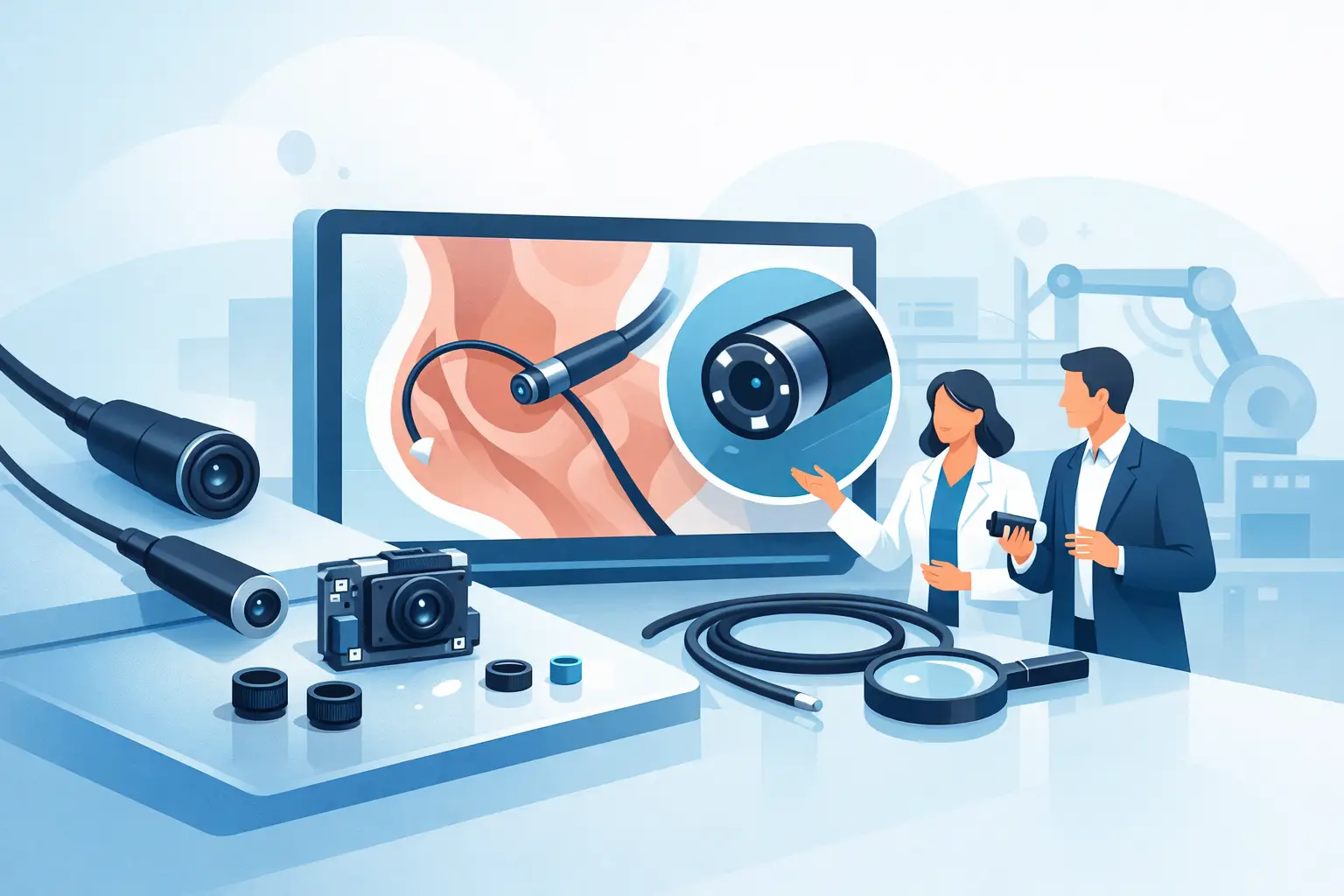
A spec sheet can make almost any camera look qualified. The real test starts when your device needs a 1.0 mm to 3.9 mm module, stable image quality, predictable lead times, and engineering support that does not slow your launch. That is where the choice of an endoscope camera module supplier becomes a product decision, not just a sourcing task.
For OEMs, medical device teams, and industrial equipment makers, the supplier affects more than component cost. It affects integration risk, validation time, regulatory planning, and whether your product can scale from pilot build to volume production without changing optics, interfaces, or assembly methods halfway through the project. If the application is tight on diameter, heat, power, or lighting, supplier capability matters even more.
What to look for in an endoscope camera module supplier
The first question is not price. It is whether the supplier can match the module to the real operating environment. Endoscope designs live inside narrow mechanical envelopes and often work in difficult lighting conditions. A module that performs well on a bench may struggle once it is placed inside a catheter, a handheld inspection tool, or a compact medical or industrial housing.
That is why experienced buyers usually start with fit, image path, and interface. Diameter range, cable structure, focal length, depth of field, illumination method, shielding, and connector choice all affect whether integration will be straightforward or painful. If the supplier cannot discuss these details clearly, the project will likely become reactive later.
A qualified supplier should also be able to support multiple module structures. In many projects, integrated endoscope camera modules are the fastest path when space, cable routing, and assembly flow are already defined. Separate camera modules can be the better choice when the product architecture demands more flexibility between the sensor head and the processing board. Neither is automatically better. It depends on your mechanical stack-up, target image quality, and serviceability requirements.
Image performance is more than resolution
Buyers often begin with resolution because it is easy to compare. But endoscope performance depends just as much on lens quality, sensor sensitivity, illumination design, color consistency, distortion control, and signal stability. A higher-resolution sensor is not always the right answer if the optics are constrained by ultra-small diameter requirements or if the system will operate in low light.
For example, a compact industrial inspection tool may need stronger close-range clarity and better resistance to flare than headline pixel count. A medical application may care more about color fidelity, uniform illumination, and low noise. A WiFi endoscope may prioritize power balance and transmission efficiency. The supplier should be able to explain the trade-offs rather than pushing the same module architecture into every use case.
This is also where ready-made modules and custom development diverge. Off-the-shelf options can reduce development time when your requirement fits common diameters, standard sensor combinations, and established interface choices. Custom work becomes valuable when you need a specific outer diameter, side-view design, LED layout, waterproofing level, or board-to-cable structure that a catalog part cannot provide cleanly.
Why manufacturing capability matters as much as engineering
Many sourcing problems do not start in the design review. They start after approval, when sample quality cannot be repeated at production scale. An endoscope camera module supplier should be evaluated not only on prototype responsiveness but also on process control, cleanroom manufacturing, inspection methods, and output consistency.
This matters because endoscope modules are sensitive assemblies. Small variation in lens positioning, bonding, cable handling, or LED placement can create visible differences in image sharpness, brightness, and reliability. In medical and industrial devices, that variation can become a field issue quickly.
Procurement and engineering teams should ask practical questions. Can the supplier maintain stable quality across volume runs? Are standard modules and custom projects produced under the same quality discipline? How are incoming components, optical alignment, and final image tests controlled? What is the typical sample turnaround, and what changes when the program moves to mass production?
A supplier with strong manufacturing depth usually gives clearer answers because it has already built the process around repeatability. That includes production capacity, traceability, and the ability to handle demand increases without rebuilding the supply chain from scratch.
Customization speed can shorten the whole product cycle
In endoscope integration, delays rarely come from a single dramatic failure. More often, they come from a series of small mismatches – the connector interferes with the housing, the focal range is slightly off, the LEDs run hotter than expected, or the cable bend radius complicates assembly. Each fix adds another round of samples.
A supplier with fast customization capability can reduce that cycle significantly. That does not mean rushing changes without discipline. It means having engineering, tooling, optical assembly, and production planning close enough together to turn feedback into revised samples quickly and accurately.
For device makers, this can be a major commercial advantage. A supplier that can adapt sensor selection, lens stack, FPC structure, cable length, and interface requirements early in development helps reduce redesign cost later. This is especially important for embedded products where the camera module affects enclosure design, PCB layout, thermal planning, and firmware tuning at the same time.
Application fit should guide supplier selection
The best endoscope camera module supplier for one sector may not be the best for another. Medical device buyers often need tighter discussion around imaging consistency, miniaturization, validation support, and application-specific optical behavior. Industrial customers may focus more on ruggedness, lighting strategy, insertion constraints, and cost control over larger production volumes.
That is why application history matters. A supplier serving both medical endoscope camera module and industrial endoscope camera module projects usually has broader experience with different environmental and mechanical requirements. Side-view, LED, WiFi, integrated, and separate module formats each solve different product problems. The more precisely the supplier matches these formats to your use case, the lower your integration risk.
In practice, this means your qualification process should include real use conditions. Request samples that reflect your actual cable length, viewing direction, lighting requirement, and image output path. Bench testing a near-match module is useful, but it is not enough if your final product depends on very small packaging tolerances.
Signs a supplier is ready for long-term partnership
A serious supplier does not hide behind broad claims. It provides concrete ranges, explains what can and cannot be customized, and communicates where trade-offs exist. If your design needs an ultra-small diameter, you may need to compromise on sensor size or illumination intensity. If your target price is aggressive, the supplier should explain what that changes in optics, housing, or assembly complexity.
Consistency in communication is another strong signal. During supplier evaluation, notice whether engineering questions are answered directly, whether sample revisions are documented clearly, and whether lead time guidance stays stable. A partner that is organized during sampling is more likely to stay organized when your production forecast changes.
This is one area where an established manufacturer has an advantage over a trading source. Direct production control usually means better alignment between sales, engineering, and factory execution. For buyers managing launch schedules, that alignment can save weeks.
One example in this space is SincereFull, the endoscope-focused brand of SincereFirst, which supports ready-made and custom endoscope camera modules across diameter ranges from 0.9 mm to 10.0 mm. What matters more than the name, though, is the underlying capability model: real engineering support, defined module families, and production capacity that can keep pace with commercial demand.
How buyers can qualify faster
The fastest way to compare suppliers is to go beyond generic RFQs. Share your target diameter, viewing direction, interface, resolution expectations, cable constraints, lighting needs, and intended environment up front. If sterilization, waterproofing, or mechanical insertion forces matter, state that early too. A capable supplier will use that information to narrow options quickly and tell you where custom work is justified.
It also helps to ask for recommendation logic, not just quotations. Why was a given sensor chosen? Why is one lens configuration better for your working distance? Why should you choose an integrated module instead of a separate one? These answers reveal whether the supplier is solving your imaging problem or simply offering inventory.
Price still matters, of course. But with endoscope modules, the cheapest source can become the most expensive if image inconsistency, redesign cycles, or delayed production force your team to requalify parts later.
Choosing well means selecting a supplier that can think like an engineer, build like a manufacturer, and respond like a partner when your design moves from concept to scale.