
A robot vision camera module can make or break a robotics project long before the robot reaches production. Teams often focus first on algorithms, motion control, or compute hardware, then discover that image noise, lens distortion, interface limits, or mechanical fit are what actually slow development. In practice, vision performance starts with the module itself.
For OEMs, robotics developers, and system integrators, the right module is not simply the highest resolution part on a datasheet. It is the camera system that fits the robot’s working distance, lighting conditions, latency target, power budget, enclosure constraints, and manufacturing plan. That is why camera selection needs to be treated as an engineering decision, not a purchasing shortcut.
What a robot vision camera module needs to do
In robotics, vision is rarely passive. The camera is feeding navigation, positioning, inspection, measurement, grasping, or obstacle detection in real time. That changes the requirements. A module used in a consumer device may look acceptable on paper, but if it introduces motion blur on a mobile robot or struggles under mixed factory lighting, it becomes a system bottleneck.
A robot vision camera module usually needs to balance five variables at once: image quality, speed, interface compatibility, mechanical integration, and long-term supply stability. Improving one area can affect another. Higher resolution may increase data load and latency. A wider field of view may reduce detail at distance. A very compact module may limit thermal margin or optical flexibility. This is why there is no single best module for every robot.
Sensor selection matters more than headline resolution
Resolution gets attention because it is easy to compare, but robotics applications depend just as much on sensor architecture, pixel size, frame rate, dynamic range, and low-light behavior. If a robot is identifying edges, reading codes, locating parts, or detecting free space, clean and consistent image data matters more than a large pixel count.
For mobile robots and autonomous platforms, frame rate and latency often matter more than ultra-high resolution. A lower resolution sensor with stable high-speed output can produce better real-world performance than a higher resolution sensor that overloads the processor pipeline. In industrial arms and pick-and-place systems, the priority may shift toward fine detail, repeatability, and controlled distortion.
Dynamic range is another common dividing line. Robots operating near windows, in warehouses, or in outdoor agriculture can face sharp contrast changes within the same frame. If the sensor cannot preserve details in both shadows and highlights, detection accuracy drops quickly. The sensor should be chosen for the actual light environment, not the ideal lab image.
The interface defines integration effort
One of the fastest ways to lose time in development is choosing a camera with the wrong output interface for the robot’s processor or host system. MIPI camera modules are often preferred in embedded robotics because they support compact integration, direct connection to application processors, and efficient high-speed image transfer. USB camera modules are useful when teams need faster evaluation, broad compatibility, or plug-and-play testing on industrial PCs and development platforms.
DVP can still be relevant for legacy embedded designs or cost-sensitive systems, but it is not always the best fit for advanced robot vision workloads. The interface should be chosen based on compute architecture, bandwidth requirement, cable length, driver support, and production intent. A module that is easy to test on a bench is not always the module that scales cleanly into a commercial robot.
This is one reason many OEMs look for a supplier that can support both standard interfaces and tailored integration. If your prototype uses USB for fast software work, but your production robot needs MIPI for compact embedded deployment, planning that transition early can reduce redesign risk.
Optics can improve or limit the entire vision stack
A strong sensor cannot compensate for the wrong lens. In robotics, lens choice determines field of view, working distance, distortion, depth of field, and image brightness. These are not cosmetic variables. They directly affect measurement reliability, object detection confidence, and calibration accuracy.
A warehouse robot may need a wider field of view to detect obstacles and navigate narrow aisles, but excessive wide-angle distortion can complicate mapping and edge estimation. A robotic arm doing inspection may need tighter framing and sharper corner performance. An agricultural robot may need optical tuning that handles variable sunlight, dust, and long-range targets.
The lens and sensor should be treated as a matched system. Chief ray angle, sensor size, mount structure, and optical center alignment all influence final image quality. For compact robots, the challenge is often fitting the optical path into a small mechanical envelope without sacrificing illumination or sharpness. That is where customized module design becomes valuable.
Mechanical and electrical constraints are rarely secondary
Many camera selections look correct until the team starts packaging the robot. Module dimensions, connector orientation, flex routing, board mounting, shielding, and heat behavior all affect integration. A camera that performs well on an open bench may become unstable inside a sealed chassis exposed to vibration, dust, and motor noise.
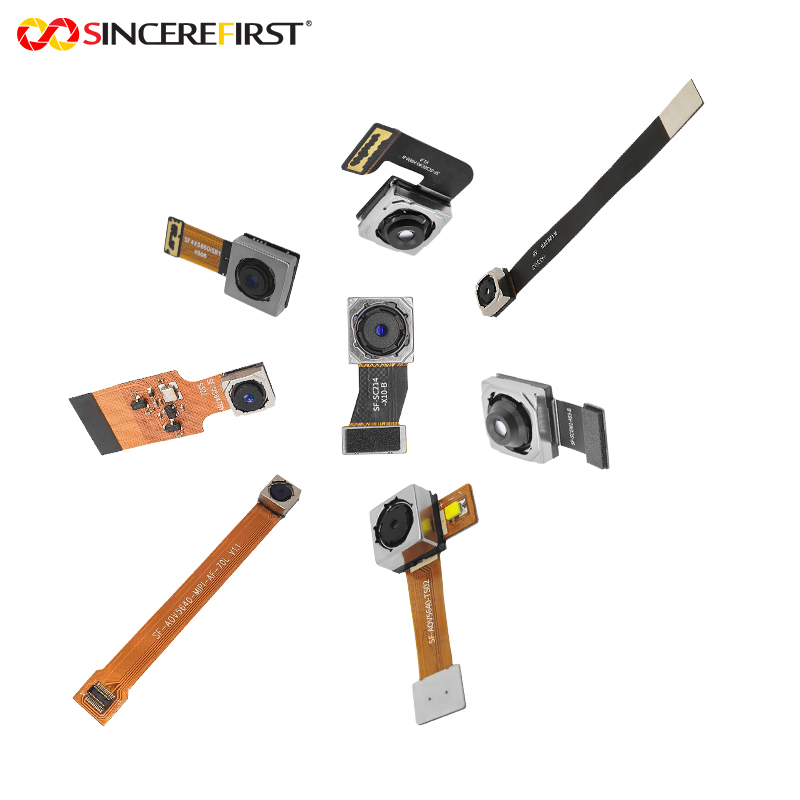
This is especially true for autonomous mobile robots, service robots, and collaborative systems with tight internal space. The module may need a specific board shape, a custom FPC length, a connector position that avoids interference, or an optical stack that fits behind a protective window. In these cases, the supplier’s customization capability matters as much as the component specification.
Electrical compatibility also needs early attention. Voltage rails, EMI sensitivity, synchronization requirements, and processor support all shape the final architecture. If the vision system includes multiple cameras, timing and bandwidth become even more critical. A supplier that can support camera tuning, connector adaptation, and interface matching can save weeks of rework.
Why manufacturing capability matters in robot vision camera module supply
For commercial robotics, a module is not only an engineering part. It is also a production component. That means sample speed, process control, consistency, and lifecycle planning all matter. A promising module from an unstable supply chain can create more risk than a slightly less aggressive specification from a qualified manufacturer.
Procurement teams and product managers should evaluate whether the supplier can support pilot builds and scaled volume with the same quality standard. Cleanroom assembly, optical alignment control, incoming material traceability, test coverage, and sensor sourcing discipline all contribute to field reliability. This is especially important when robots are deployed in medical, industrial, security, or public infrastructure settings where service failure is expensive.
Fast prototyping is valuable, but only if the path to mass production is equally clear. An engineering-led manufacturer can help bridge that gap by supporting sample iteration, image tuning, and custom mechanical updates without forcing the customer to restart qualification from scratch later.
When standard modules work and when custom design is better
A standard camera module is often the right choice when the robot uses common interfaces, standard mounting geometry, and moderate image requirements. It speeds early testing and helps teams validate software and system behavior quickly. For many robotics projects, this is the smartest starting point.
Custom development becomes the better route when the robot has unusual space limits, specific lens needs, specialized lighting conditions, or strict performance targets. It also makes sense when the product is intended for scale and requires stable long-term configuration control. In those cases, modifying the board layout, lens structure, connector type, cable format, or image parameters can produce a much better commercial result than forcing a standard module into a nonstandard design.
SincereFirst works with OEMs and integrators in this exact space, where off-the-shelf speed is useful but production-grade customization is what gets the device shipped.
Questions to ask before you commit
Before selecting a robot vision camera module, ask how the robot actually sees, not just what the datasheet lists. What is the working distance? What is the motion speed? Is the scene controlled or unpredictable? Does the robot process images locally or send them to a host? How much latency can the control loop tolerate? What happens if a sensor revision changes in 12 months?
These questions expose trade-offs early. They also help determine whether you need a standard USB module for fast proof-of-concept work, a compact MIPI module for embedded deployment, or a customized solution built around your optics, interface, and housing constraints.
The best camera choice is usually the one that reduces total development friction. It fits the processor, delivers stable images in real conditions, supports manufacturable packaging, and comes from a supplier that can still support you when volumes increase.
A robot does not need a camera that looks impressive in isolation. It needs a vision module that keeps performing when the full system is moving, calculating, and shipping at scale.