
A sensor decision made early can determine whether a vision product performs reliably on the production floor or struggles under real lighting conditions. Bayer versus monochrome sensors is not simply a choice between color and black-and-white output. It affects optical design, illumination requirements, processing load, inspection accuracy, module size, and the cost of scaling production.
For OEMs, robotics developers, medical device teams, and industrial integrators, the right choice starts with the information the camera must capture. If color itself is a pass-fail criterion, a Bayer sensor is usually necessary. If the objective is to detect small features, maximize sensitivity, or operate under controlled illumination, a monochrome sensor may provide more usable image data from the same optical format.
How Bayer and Monochrome Sensors Capture Light
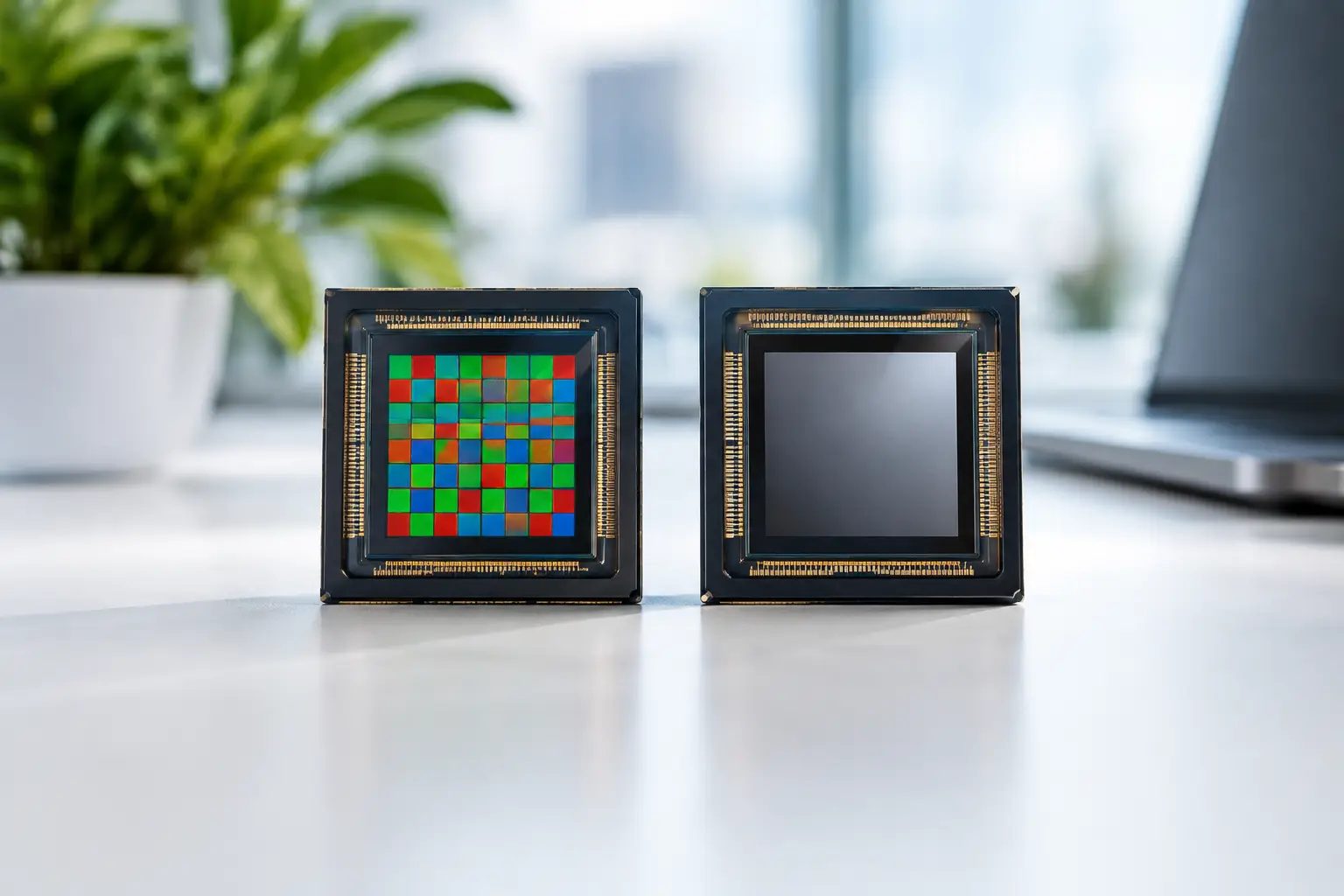
A monochrome image sensor records the total light intensity reaching each pixel. Every pixel contributes directly to the image, subject to the sensor’s spectral response and any filter placed in front of the lens. The result is a grayscale image with strong native detail, high light efficiency, and a straightforward processing path.
A Bayer sensor places a color filter array over the pixel grid. The common Bayer pattern uses red, green, and blue filters, with twice as many green pixels as red or blue pixels because the human visual system is especially sensitive to green detail. Each pixel measures only one color channel. The image signal processor then uses demosaicing to estimate the missing color information at every output pixel.
That reconstruction process is effective for consumer imaging, document capture, retail analytics, and many general-purpose smart devices. But it is also the central engineering difference. A Bayer sensor does not measure full RGB data at every photosite. It reconstructs color from neighboring pixels, which can affect fine edges, repeating patterns, and measurement consistency.
Bayer Versus Monochrome Sensors in Real Applications
The most practical question is not which sensor is universally better. It is which sensor preserves the contrast, spatial detail, and spectral information required for the inspection or imaging task.
When color is the required data
Choose a Bayer sensor when hue or color category is part of the decision. Examples include verifying wire colors, sorting fruit by ripeness, detecting package label variations, identifying skin tone characteristics in certain medical imaging workflows, or monitoring traffic signals. A color camera can also make human review easier because operators see a familiar representation of the scene.
Bayer sensors are often the efficient choice when a device must serve several functions at once. A smart security terminal, for example, may need color evidence during daylight, while also using AI analytics for people or vehicle detection. In these cases, the color signal can add meaningful context beyond shape and brightness.
Color performance, however, depends on more than the sensor. Illumination spectrum, auto white balance behavior, lens shading, color correction matrices, exposure control, and image signal processor tuning all influence the delivered image. For a commercial product, consistent color requires validation across production lots and expected operating conditions.
When sensitivity and fine contrast matter most
Choose a monochrome sensor when the target can be separated by brightness, texture, edge contrast, or response to a selected wavelength. Without red, green, and blue filters blocking portions of incoming light, monochrome pixels typically collect more useful light. This can enable shorter exposures, lower gain, reduced motion blur, and improved performance in dim scenes.
That advantage is particularly valuable in high-speed inspection. A conveyor application may need to freeze motion while detecting small print defects, surface scratches, pinholes, or component placement errors. More signal at the sensor can reduce the lighting power and exposure time needed to achieve a stable result.
Monochrome imaging is also a strong match for narrowband illumination. Under red, near-infrared, ultraviolet, or other application-specific wavelengths, a monochrome sensor can use the selected illumination efficiently. A Bayer sensor may lose significant response because only a portion of its filtered pixels are well matched to that wavelength. The exact result depends on sensor spectral curves, filter design, and the illumination source, so this should be tested rather than assumed.
Resolution is not only a megapixel number
A Bayer camera may advertise the same sensor resolution as a monochrome version, but their usable detail can differ. A monochrome sensor samples luminance at every pixel location. Bayer output relies on interpolation, which can soften very fine detail or introduce color artifacts around sharp transitions.
For barcode reading, metrology, semiconductor inspection, printed circuit board analysis, and machine vision measurement, this distinction can be decisive. A monochrome camera can often provide cleaner edges and more repeatable feature localization when color carries no value.
This does not mean every monochrome camera automatically outperforms every color camera in resolution. Lens quality, focus stability, pixel size, shutter type, sensor architecture, object distance, and image processing all matter. The correct comparison uses the same sensor family, optics, field of view, illumination, and acceptance criteria.
The System Trade-Offs That Affect Camera Module Design
Sensor selection should be evaluated at the module and system level, not as an isolated component specification. A lower-cost sensor can create higher costs elsewhere if it requires brighter illumination, more processing, longer tuning cycles, or complex corrective algorithms.
Bayer modules generally require an image signal processor pipeline capable of demosaicing, white balance, color correction, noise reduction, and often gamma processing. In MIPI camera modules for embedded devices, some of this work may occur in the host SoC. In USB camera modules, it may be handled within the camera electronics or by the connected system. Engineers should confirm where processing occurs, the output format, and whether the host has sufficient bandwidth and compute capacity.
Monochrome modules can simplify the output path when grayscale data is all that is needed. This may reduce processing overhead and make algorithm behavior easier to control. It can also support smaller data payloads in applications where an 8-bit or 10-bit monochrome stream is sufficient. Yet monochrome is not automatically simpler in every case. Specialized lighting, optical filters, or a separate color camera may be required if the product later needs visual documentation or operator-friendly color images.
Low-light performance deserves a realistic review as well. A monochrome sensor often has a sensitivity advantage, but read noise, quantum efficiency, pixel size, exposure limits, and lens aperture can outweigh the effect of the color filter array. For moving scenes, a global shutter sensor may be more valuable than the Bayer or monochrome choice alone. For stationary scenes, a rolling shutter sensor with longer exposure may be entirely suitable.
A Practical Selection Process for OEM Teams
Start by defining the inspection decision in measurable terms. State what must be detected, the smallest feature size, acceptable false-pass and false-reject rates, object speed, working distance, lighting constraints, and required output interface. A sensor should be selected against those requirements, not against a generic image-quality ranking.
Then test representative targets under realistic lighting. Use actual materials, surface finishes, colors, motion conditions, and background variation. If the system will operate under LED illumination, test the exact LED wavelength and drive condition. A monochrome sensor may reveal defects that a color sensor smooths away, while a Bayer sensor may identify color differences that are invisible in grayscale.
Evaluate the complete image chain. Compare the lens modulation transfer performance, sensor response, exposure time, gain, output bit depth, compression, and algorithm result. Looking only at sample images can be misleading. The useful metric is whether the camera consistently supports the product’s decision threshold.
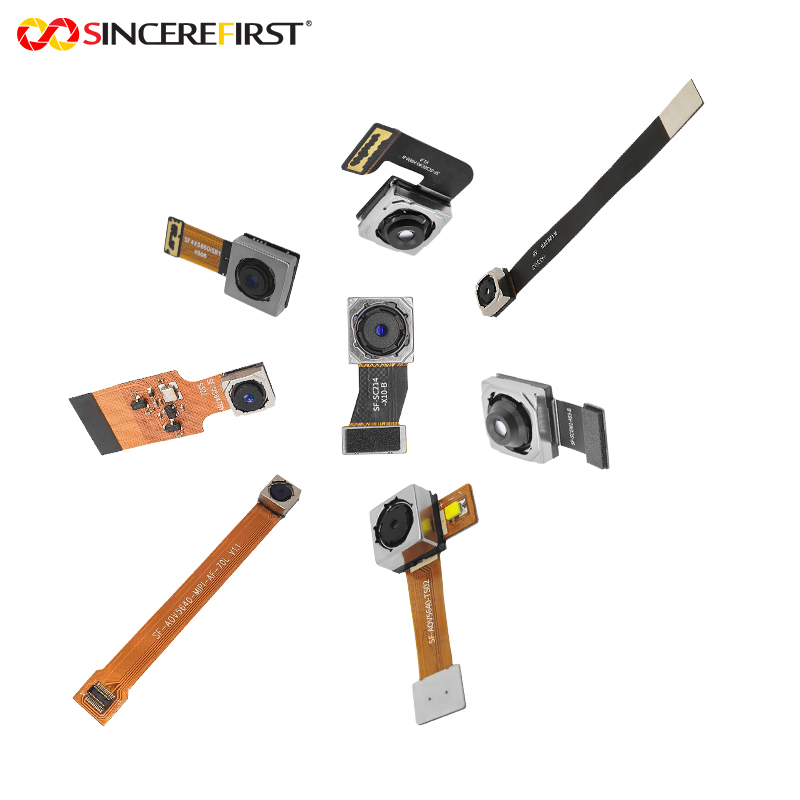
Finally, consider production readiness. A camera module for an industrial or medical product needs stable component sourcing, optical alignment control, electrical validation, interface compatibility, and a defined quality process. Customization may involve sensor selection, lens field of view, IR-cut or bandpass filters, FPC length, connector type, module dimensions, USB or MIPI output, and firmware configuration. These elements should be engineered together to avoid late-stage redesign.
SincereFirst supports this approach with standard and custom camera module development for embedded and industrial imaging programs, helping teams align sensor, optics, interface, and manufacturing requirements before volume production.
The best next step is to put both options in front of the real target and measure the outcome. A Bayer sensor earns its place when color changes the decision. A monochrome sensor earns its place when every photon, edge, and millisecond matters.