
A rolling-shutter camera can produce a sharp-looking image of a stationary part, then fail the moment a robot arm, conveyor, or handheld scanner starts moving. That is the practical reason an OV9281 sensor review should begin with shutter behavior rather than megapixels. The OV9281 is a 1-megapixel monochrome image sensor designed for applications where motion accuracy, compact integration, and predictable timing matter more than high-resolution color imaging.
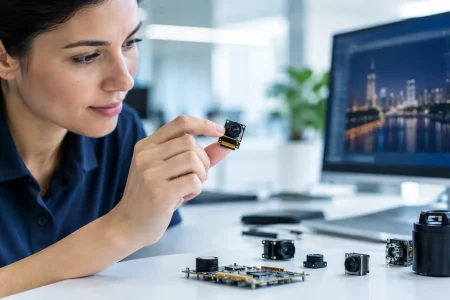
For OEMs and system integrators, this sensor remains a strong candidate for entry-level and mid-range machine vision devices. It is particularly useful when the design needs fast capture in a small camera module, but the final result depends heavily on lens selection, illumination, interface design, and manufacturing control.
OV9281 Sensor Review: Core Performance
The OV9281 is built around a 1280 x 800 active pixel array with 3.0 µm pixels and a global shutter architecture. Global shutter exposure means all pixels capture the scene at the same instant. Unlike a rolling shutter, it does not scan across the image line by line. This minimizes geometric distortion and motion skew when the subject or camera is moving.
That characteristic has direct value in barcode reading, gesture tracking, robot guidance, object sorting, visual odometry, and stereo vision. A fast-moving object remains shaped like the object, rather than appearing slanted or stretched. For algorithms that calculate position, speed, edges, or feature points, this can be more valuable than adding resolution.
The sensor can support frame rates up to 120 frames per second at full 1280 x 800 resolution under appropriate operating conditions. Actual camera-level frame rate is not determined by the sensor alone. The selected interface, cable length, ISP or host capability, exposure setting, output format, and system bandwidth all affect the usable result. Buyers should request validation data from the complete module, not rely only on the sensor datasheet maximum.
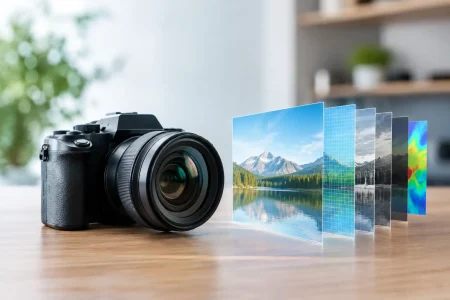
As a monochrome sensor, the OV9281 does not capture color information. This is an advantage when the application is based on contrast, geometry, infrared response, or pattern recognition. Without a color filter array, the sensor can provide cleaner luminance detail and better light efficiency than a comparable color module. It is not the right choice when product color verification, skin-tone rendering, or consumer-style imaging is a core requirement.
Why Global Shutter Matters in Real Equipment
Global shutter is sometimes treated as a premium specification, but its value is highly application-dependent. If a camera only captures static documents under controlled lighting, a rolling-shutter sensor may be more economical and may offer higher resolution. If the camera is mounted on a mobile robot or images parts moving at production speed, shutter choice can determine whether the vision algorithm works consistently.
Consider a robotic picking system. The camera must identify a part’s location before the gripper moves. With rolling shutter, rapid conveyor motion can shift edge positions across the frame and create uncertain coordinates. With the OV9281, the entire frame represents one exposure moment. That improves the reliability of downstream measurement and tracking, provided lighting is sufficient to use a short exposure time.
The same principle applies to active stereo systems. Two cameras need synchronized captures to calculate depth accurately. Global-shutter sensors make synchronization more practical, especially when paired with an external trigger and controlled illumination. Timing still needs careful engineering. Trigger latency, cable routing, sensor configuration, and host processing must be assessed at the module and system level.
Interface and Integration Considerations
OV9281 camera modules are commonly designed around MIPI CSI-2 or parallel DVP output, depending on the target processor and legacy hardware requirements. MIPI CSI-2 is typically the practical choice for compact embedded platforms because it supports high-speed data transfer with fewer interconnects. It is widely used with application processors, SBCs, AI edge devices, and custom embedded boards.
DVP can remain relevant for established controller architectures, evaluation platforms, and products that need a simpler parallel connection. However, it generally requires more PCB routing resources and may be less suitable for highly compact designs. The correct choice starts with the host, not the camera module catalog.
A complete integration review should also confirm whether the processor supports the required sensor driver, clocking, lane configuration, pixel format, and frame timing. The sensor can deliver strong raw data while the project still loses time on software tuning or driver compatibility. For commercial products, teams should validate startup behavior, repeated streaming, temperature performance, electromagnetic compatibility, and supply-chain longevity before freezing the design.
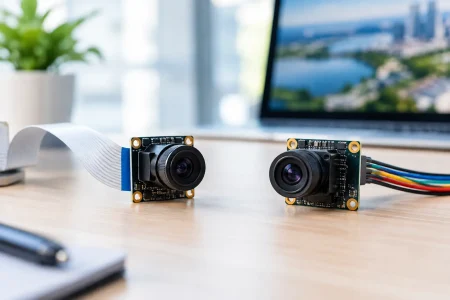
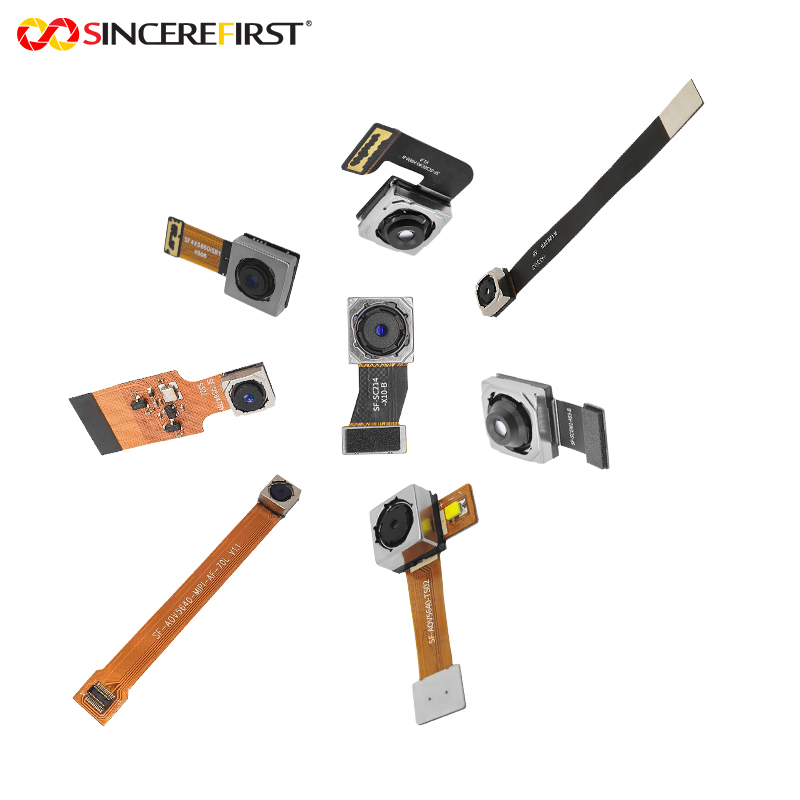
The physical module deserves equal attention. FPC camera modules are effective when the camera must fit into a thin enclosure or a restricted optical position. Board-level modules can be more stable where a fixed mechanical assembly and connector retention are priorities. USB camera modules simplify integration for industrial PCs and rapid prototypes, but the USB bridge, compression option, and host bandwidth can introduce different constraints from a direct MIPI design.
Optics and Illumination Define the Usable Image
An OV9281 module is not automatically a high-performance vision camera because it uses a global-shutter sensor. Lens quality and lighting strategy have a major effect on image contrast, corner sharpness, distortion, and repeatability.
The 3.0 µm pixel size provides useful sensitivity for a compact global-shutter sensor, but short exposure times still require enough light. A production line running at high speed may need pulsed LED illumination to freeze motion without excessive gain. Increasing gain can brighten a frame, but it also raises noise and can reduce the reliability of thresholding, decoding, and feature extraction.
Lens selection should start with the working distance, field of view, target size, and required measurement accuracy. A wide-angle lens can cover more scene area but may introduce distortion that must be calibrated. A narrow field of view can provide more pixels on a target but may be harder to align mechanically. Fixed-focus optics are efficient for controlled distances, while adjustable-focus assemblies are useful during prototyping or when the product must serve multiple installation conditions.
For near-infrared applications, the module should be specified as a system. Sensor response, IR-cut filter choice, lens coating, LED wavelength, and exposure control need to work together. A standard visible-light module may not produce the expected result under 850 nm or 940 nm illumination without optical customization.
Where the OV9281 Fits Best
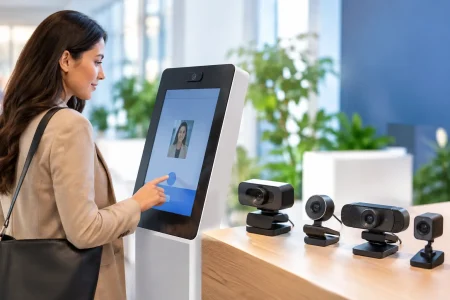
The OV9281 is a practical fit for compact vision products that value speed and motion integrity over image size. Typical applications include robotics navigation, handheld scanners, autonomous guided vehicles, industrial code readers, drone stabilization, occupancy sensing, gesture control, smart retail devices, and machine inspection systems with defined defect sizes.
It can also be a useful stereo-camera sensor because its global shutter supports matched frame capture across two optical channels. Yet 1 megapixel limits the depth detail and detection range compared with higher-resolution alternatives. For close-range obstacle avoidance, tracking, or structured-light tasks, that trade-off can be entirely reasonable. For long-range inspection or fine-surface defect detection, a higher-resolution global-shutter sensor may be the better engineering decision.
The sensor is also not intended to replace a high-quality consumer imaging sensor. Its strengths are timing, monochrome contrast, compact size, and frame rate. If the device needs polished color imagery for a user-facing screen, teams should evaluate a color sensor separately or consider a dual-camera architecture.
What to Verify Before Selecting an OV9281 Module
A supplier quotation should identify more than resolution and interface. The most useful technical discussion covers the actual operating environment and acceptance criteria. Before committing to an OV9281 design, confirm these points:
- Full-resolution frame rate at the intended pixel format and host configuration
- Lens focal length, field of view, distortion, focus tolerance, and IR filter configuration
- Trigger, strobe, synchronization, and exposure-control requirements
- Image quality consistency across pilot and volume production batches
- Mechanical dimensions, FPC orientation, connector type, mounting method, and cable length
- Module operating temperature, reliability testing, and quality inspection process
For OEM programs, sample speed matters, but sample-to-production consistency matters more. A module that performs well on an engineering bench can still create expensive rework if lens alignment, sensor placement, or firmware settings vary in volume manufacturing. This is where an experienced module manufacturer adds value through controlled assembly, optical inspection, process traceability, and the ability to adjust the module around the final device enclosure.
SincereFirst can support OV9281-based module development with interface, optics, mechanical, and production customization aligned to embedded vision requirements. That approach is especially relevant when the camera must fit a nonstandard housing, integrate with a specific processor board, or maintain stable imaging performance across scaled production.
The Practical Buying Decision
The OV9281 remains a well-judged sensor for monochrome machine vision systems that need clean captures of moving scenes. Its global shutter and high frame-rate capability address problems that additional megapixels cannot solve, while its compact format supports tightly integrated devices.
The right question is not whether the OV9281 is the best sensor in general. It is whether its 1280 x 800 monochrome output, timing behavior, lens options, and interface match the scene your device must capture. Start by testing the module under real motion, real lighting, and real host processing conditions – that is the fastest path to a camera design that performs reliably after deployment.