
A camera module can meet resolution and interface requirements yet still fail the user experience because focus performance was treated as a late-stage detail. In the liquid lens versus VCM decision, the correct actuator depends less on a single headline specification than on the working distance, motion profile, optical stack, environmental demands, and production tolerances of the finished device.
For OEMs building barcode readers, handheld medical devices, robots, inspection equipment, smart terminals, or compact security products, autofocus is a system-level choice. It affects image sharpness, capture latency, module thickness, power behavior, mechanical durability, and the calibration effort required at scale.
How VCM Autofocus Works
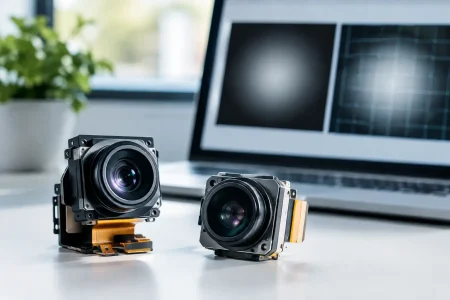
A voice coil motor, commonly called a VCM, moves a lens element or lens group along the optical axis. Current through a coil interacts with a permanent magnet, creating the force needed to shift the lens to the requested focus position. This is the established autofocus architecture in a large share of smartphone and compact camera modules.
The key advantage is optical flexibility. A VCM can translate a lens group over a meaningful travel range, allowing designers to support close focusing while maintaining image quality at longer distances. It can also be paired with lens designs that need physical displacement to achieve the desired focus range. For applications that benefit from conventional contrast-detect autofocus behavior, VCM remains a proven and broadly available option.
That mechanical movement creates practical constraints. The moving mass must accelerate, settle, and stop without excessive overshoot. Focus speed is therefore influenced by lens mass, spring characteristics, motor force, damping, control algorithms, and temperature. VCM modules may also need more attention to drop performance, wear, audible movement, and position repeatability over a long operating life.
VCM is often the right fit when a product needs a relatively large focus travel range, cost-sensitive volume production, or an optical architecture already validated around a moving lens group. It is especially practical when autofocus is useful but not continuously critical to the operating cycle.
How Liquid Lens Autofocus Works
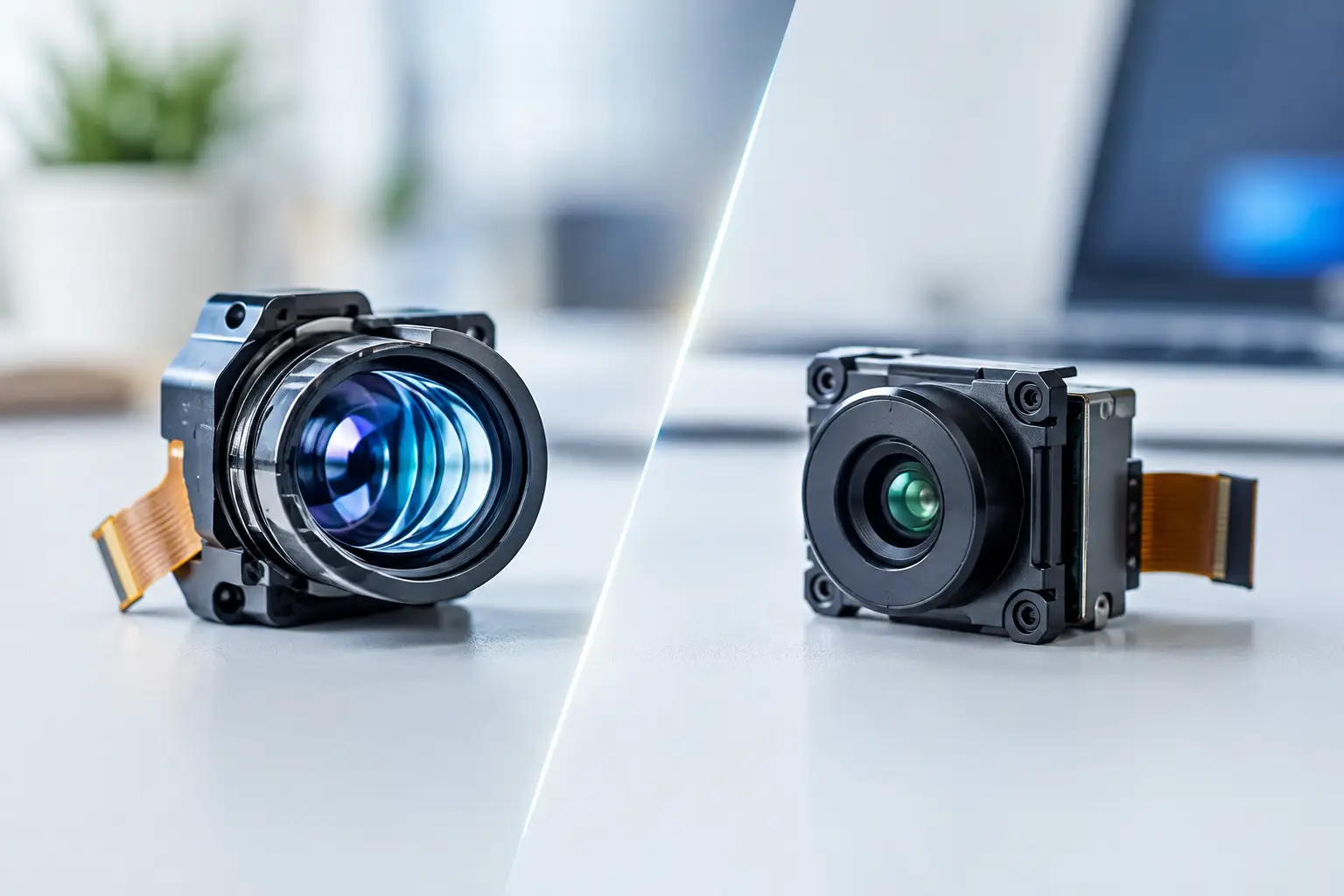
A liquid lens changes optical power by changing the shape of an interface between two transparent liquids. In many designs, electrowetting adjusts that interface when voltage is applied. Rather than physically moving a glass lens group through the module, the liquid lens changes its focal length with very little moving mass.
This approach can deliver exceptionally fast focus transitions. With no conventional spring-and-coil lens carriage to move, the lens can respond quickly and repeatedly, which is valuable when a scanner, inspection camera, or mobile robot must acquire focus across varying object distances. Liquid lenses can also operate with low power consumption while holding a focus state, depending on the lens technology and drive method.
Their compact construction and high shock resistance are major reasons liquid lenses are specified in industrial equipment. A warehouse scanner dropped during a shift, a camera mounted to a vibrating machine, or a portable diagnostic device can benefit from an autofocus component with fewer mechanical parts in motion.
However, a liquid lens is not a universal replacement for VCM. Its usable optical power range, aperture compatibility, image circle, wavelength behavior, temperature performance, and lens-stack interaction must be evaluated carefully. A liquid lens can correct focus quickly, but it does not solve every optical issue caused by field curvature, aberration, shallow depth of field, or inadequate illumination. The rest of the optical design still matters.
Liquid Lens Versus VCM: The Engineering Trade-Offs
The most useful comparison is not which technology is “better,” but which failure mode and operating requirement matter most in the end product.
Focus speed and capture timing
Liquid lenses generally have an advantage where rapid refocusing is central to the workflow. A machine vision device inspecting products at different heights, a code reader scanning near and far labels, or a medical viewer moving through a narrow workspace may need focus changes in milliseconds rather than a visibly slower mechanical sweep.
VCM performance can be very good, particularly in optimized mobile camera modules, but settling time and control behavior deserve verification under actual use conditions. If the device captures a single image after an operator pauses, the difference may have little commercial value. If it captures many images per second while object distance changes, liquid lens response can materially improve throughput.
Durability, shock, and vibration
A VCM has a moving lens assembly, magnets, springs, and mechanical stops. Quality camera modules are engineered to withstand normal handling, yet repeated shock and vibration remain relevant qualification factors. Mechanical movement can also introduce changes in behavior as components age.
Liquid lenses are often favored in high-vibration and high-cycle applications because their focusing mechanism has minimal mechanical motion. This does not eliminate the need for full module validation. The sensor package, lens barrel, adhesive selection, FPC, connector, and housing all remain part of the reliability chain. Still, liquid lens technology can reduce autofocus-specific mechanical risk.
Optical range and image quality
VCM gives optical designers a familiar way to move a lens group and can accommodate a broad variety of camera module architectures. It may be the more practical option for modules requiring larger physical focus shifts or carefully tuned multi-element lenses.
Liquid lenses are highly effective within their specified diopter range, but they need to be matched to the fixed optics, sensor size, F-number, and target working-distance range. A design intended to read labels from 50 mm to 1 m requires different optical planning from an endoscope module focused within a tight near-field range. Testing at the nearest, nominal, and farthest target distances is more meaningful than comparing actuator specifications alone.
Power, size, and acoustics
Both technologies can support compact embedded designs, but their system behavior differs. Liquid lenses can offer low moving mass, quiet operation, and an efficient focus mechanism, making them attractive for battery-operated equipment and instruments used near patients or operators.
VCM modules are common, mature, and cost-effective at scale. They may be easier to source within established mobile-oriented supply chains. Yet their mechanical operation can generate faint audible noise or vibration, which may matter in quiet medical, consumer, or laboratory products. Available module depth also needs review because the complete optical stack, not the actuator alone, determines final dimensions.
Control electronics and software
Neither autofocus technology should be selected without considering the control path. VCM typically requires a driver IC and autofocus algorithm that command lens position based on image contrast, phase data, time-of-flight input, or another focus signal. Calibration may be needed to account for lens position variation and mechanical end stops.
Liquid lenses require a compatible drive circuit, voltage profile, and control logic. Their behavior across temperature should be characterized, especially for outdoor equipment, refrigerated logistics, or industrial installations. The camera ISP must also have enough time and image feedback to make useful focus decisions. Fast hardware does not create fast autofocus if the software loop is slow or the scene lacks contrast.
Selecting the Right Autofocus Architecture
Start with the imaging task, not the preferred technology. Define the full working-distance range, smallest required feature, illumination conditions, target reflectivity, acceptable capture time, expected shock exposure, duty cycle, and operating temperature. These factors provide a clearer basis for selection than a generic request for an autofocus camera module.
A liquid lens is often a strong candidate for high-speed scanning, moving-object inspection, frequent refocusing, compact instruments, and applications exposed to shock or vibration. It can be particularly valuable when fast focus recovery directly affects read rate, inspection yield, or operator productivity.
A VCM is often a strong candidate for mainstream embedded imaging, broader conventional autofocus needs, and cost-conscious products with established mobile-camera optical designs. It remains an effective solution where mechanical focus travel and ecosystem availability outweigh the benefits of ultra-fast focus response.
For some products, fixed focus should remain in the comparison. If the working distance is tightly controlled and depth of field can cover the target zone, a fixed-focus module removes autofocus latency, actuator cost, control complexity, and a potential source of variation. In industrial imaging, the simplest optical architecture that consistently meets the requirement is often the most reliable production choice.
Validate at the Module Level, Not on Paper
Autofocus performance must be measured in the finished camera module and, ideally, in the final device housing. Lens alignment, IR-cut filter selection, sensor sensitivity, ISP tuning, illumination geometry, and mechanical mounting can all change the result. A specification sheet cannot fully predict focus behavior on low-contrast packaging, reflective metal, textured skin, or moving machinery.
A practical evaluation should include focus time, repeatability, image sharpness at key distances, response after shock and vibration, power draw during realistic capture cycles, and thermal behavior. Production teams should also confirm whether calibration is required per module and how that process will be controlled at volume.
With more than three decades of imaging development and manufacturing experience, SincereFirst approaches autofocus selection as part of the complete camera-module design: sensor, optics, interface, mechanical envelope, and production validation must work together. The best next step is to turn the real scene, distance range, and reliability target into a test plan, then choose the focus technology that proves itself under those conditions.