
A camera that performs well in a controlled lab can fail quickly in a soybean field, greenhouse aisle, or autonomous tractor enclosure. The best imaging modules for smart agriculture are not defined by resolution alone. They are selected around the crop signal that must be measured, the speed of the platform, the available processor, and the weather, dust, vibration, and light variability the device must survive.
For OEMs, agricultural robotics teams, and system integrators, the practical question is not simply which camera is best. It is which sensor, optical stack, interface, and mechanical design will produce repeatable data at production scale. A camera module for leaf inspection has different requirements from one used for drone mapping, targeted spraying, livestock monitoring, or grain grading.
How to Select the Best Imaging Modules for Smart Agriculture
Start with the decision your system needs to make. If an autonomous weeder must distinguish a crop plant from a weed in milliseconds, motion performance and color consistency matter more than an extremely high pixel count. If a greenhouse system tracks plant vigor over weeks, spectral response, illumination control, and calibration stability become the priority.
Agricultural imaging also has an unusually broad operating envelope. Direct sun can create hard shadows and saturated highlights. Dawn, dusk, cloud cover, artificial grow lights, wet leaves, dust, and reflective plastic mulch can all change the scene. A suitable module must be evaluated as part of the complete imaging chain: sensor, lens, filter, illuminator, processor, housing, cable routing, and image-processing model.
RGB MIPI Camera Modules for Crop and Plant Recognition
RGB camera modules are the most common starting point for smart agriculture because they provide the visual information used by many machine learning models. They are well suited to crop-row navigation, fruit counting, canopy coverage measurement, produce sorting, pest scouting, and operator-assistance systems.
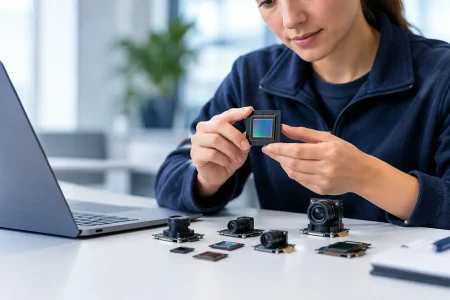
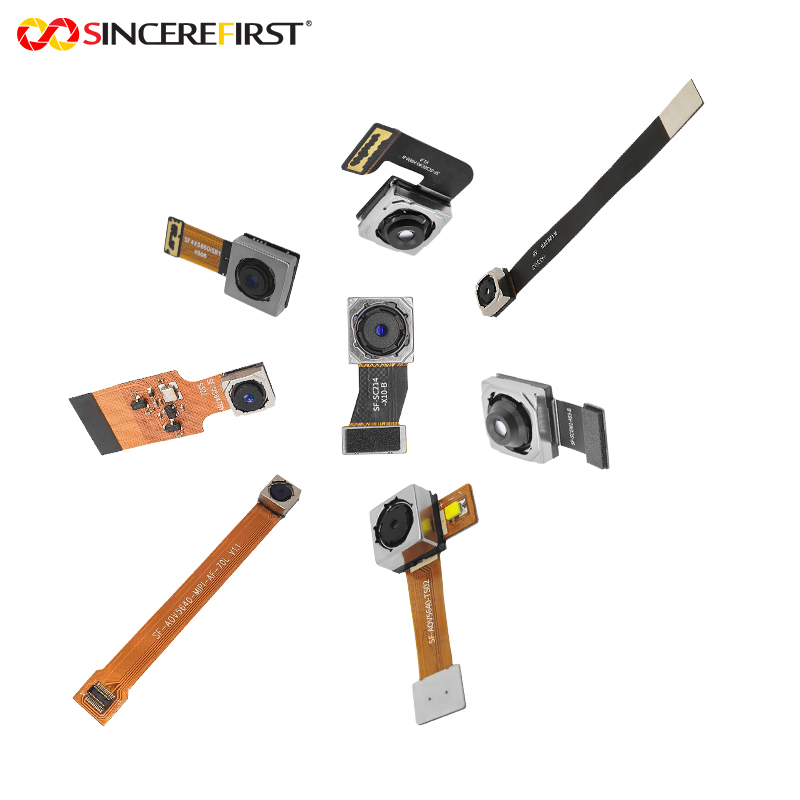
For embedded agricultural equipment, a MIPI CSI-2 camera module is often the right choice when the camera sits close to an application processor or AI system-on-chip. MIPI offers low latency and a compact connection, which supports small robotic platforms and smart implements. Sensor resolutions from 2MP to 13MP or higher can serve many applications, but the best choice depends on the required field of view and the smallest feature that must be detected.
A high-resolution rolling-shutter module can work well for stationary inspection or slow-moving greenhouse carts. On a vehicle traveling across uneven ground, however, rolling shutter may distort leaves, stems, or row lines. That distortion can reduce model accuracy even when the image appears sharp at a glance.
Global-Shutter Modules for Moving Platforms
Global-shutter imaging modules capture all pixels at the same instant. This makes them a strong fit for autonomous tractors, robotic weeders, UAV payloads, conveyor-based produce inspection, and fast phenotyping systems. They reduce motion artifacts caused by vehicle movement, vibration, rotating components, and quickly changing scene geometry.
The trade-off is cost and, in some sensor formats, lower resolution or lower sensitivity compared with a similarly priced rolling-shutter sensor. That trade-off is usually justified when imaging data directly drives a mechanical action, such as steering, robotic picking, or precision spraying. A blurred or skewed image can become an operational error rather than a minor visual defect.
Frame rate should be specified together with exposure time, illumination, and platform speed. A 60 fps sensor does not automatically freeze motion if the exposure is too long. In field conditions, a short exposure may require a larger aperture, higher sensor gain, or controlled LED illumination. Each option affects depth of field, image noise, power consumption, and system cost.
Near-Infrared and Multispectral Modules for Plant Health
Visible RGB imaging shows what a human operator can see. Near-infrared, red-edge, and multispectral imaging can reveal information related to chlorophyll activity, water stress, plant density, and disease progression before symptoms become obvious in natural color images.
A near-infrared module can be an efficient solution for vegetation segmentation and basic vigor analysis. It is particularly useful where the system needs stronger separation between plant material and soil. For more advanced crop-health measurements, a multispectral design may use discrete bands such as blue, green, red, red-edge, and NIR. These systems are used in field mapping, controlled-environment agriculture, research phenotyping, and decision-support platforms.
Multispectral performance depends heavily on optical and calibration discipline. The lens and filter must preserve the intended band response, while exposure and white-balance behavior must be controlled. Automatic image adjustments that are helpful in consumer photography can undermine measurement consistency. If the goal is to compare data from different dates, fields, or devices, radiometric repeatability matters as much as image quality.
Thermal Imaging Modules for Irrigation and Animal Monitoring
Thermal modules measure heat patterns rather than reflected visible light. In agriculture, they can support irrigation assessment, early detection of water stress, equipment-temperature monitoring, and livestock observation. They are valuable when a target must be assessed in low light or when temperature contrast provides more useful information than color.
Thermal imaging should not be treated as a replacement for RGB or NIR. Its resolution is often lower, and thermal signatures can shift with ambient temperature, wind, surface moisture, and time of day. A thermal module is frequently most effective as part of a dual-camera system, paired with an RGB module for context and target identification.
Interface and Processing Decisions Matter as Much as the Sensor
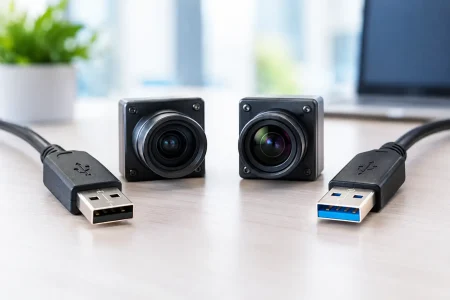
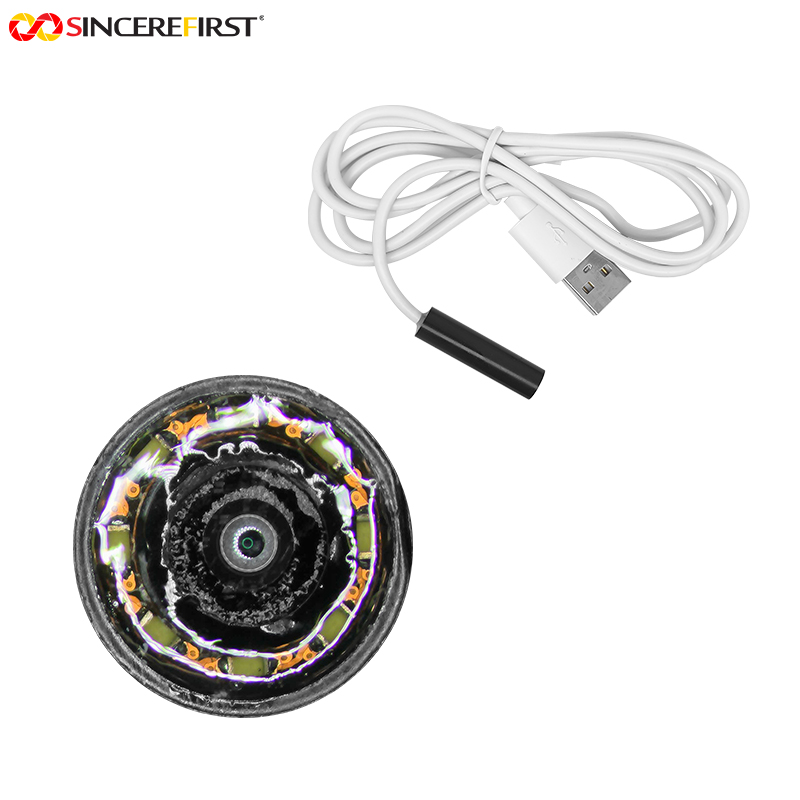
The right interface depends on the computing architecture and cable distance. MIPI camera modules are ideal for short, direct connections to embedded processors. USB 2.0 and USB 3.0 camera modules simplify integration with industrial PCs, edge computers, and prototype platforms. UVC modules can reduce driver development because they follow a broadly supported video-device standard.
USB 3.0 is a practical choice when high-resolution images or multiple camera streams must reach an edge computer with minimal compression. USB 2.0 may be sufficient for lower-resolution monitoring cameras, but bandwidth limits must be checked against frame rate and pixel format. A system that appears stable with one camera can become unreliable when several streams, AI inference, and data logging run at the same time.
DVP modules remain relevant for cost-sensitive embedded designs and legacy processors, although their parallel connection requirements can make routing less convenient than MIPI. The interface decision should be made early because it affects processor selection, board layout, enclosure design, cable length, and validation effort.
Optics and Illumination Determine Whether the Sensor Sees Useful Data
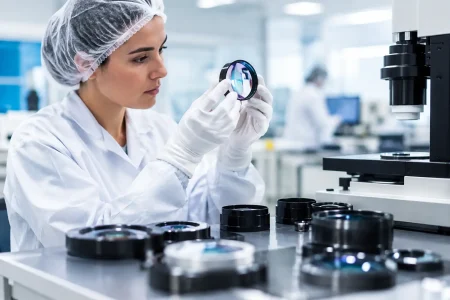
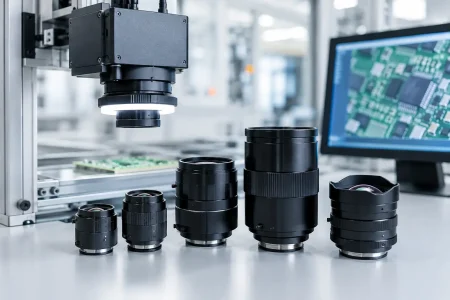
A quality sensor cannot compensate for the wrong lens. Agricultural systems often need a wide field of view to cover rows, beds, or conveyor lanes, but excessively wide lenses can introduce distortion and reduce effective detail at the edges. Lens focal length, field of view, working distance, aperture, distortion, and depth of field should be chosen against the actual camera mounting position.
For close-range fruit inspection or seed analysis, a fixed-focus lens may be sufficient when the target distance is controlled. For field robots operating over uneven terrain, greater depth of field can be more valuable than maximum aperture. In other cases, autofocus may help, but it adds mechanical complexity and can create inconsistent capture timing.
Illumination deserves the same engineering attention as the camera module. Ring lights, bar lights, NIR LEDs, polarized lighting, and strobed illumination can make image data more consistent. Controlled light can reduce the effect of shadows and glare, but it adds power, heat, and enclosure requirements. Outdoor systems still need to handle sunlight as the dominant light source, so high dynamic range and exposure strategy remain critical.
Build for Field Reliability and Manufacturing Scale
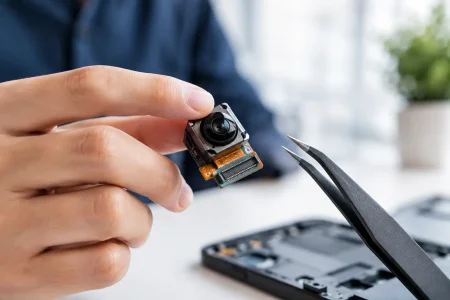
Agricultural deployments expose electronics to temperature changes, moisture, chemicals, dust, shock, and vibration. The camera module must be integrated into a protected mechanical assembly with appropriate sealing, thermal paths, strain relief, and connector retention. A compact FPC camera module may fit a tight enclosure, but the flex cable needs careful routing and support when the platform vibrates continuously.
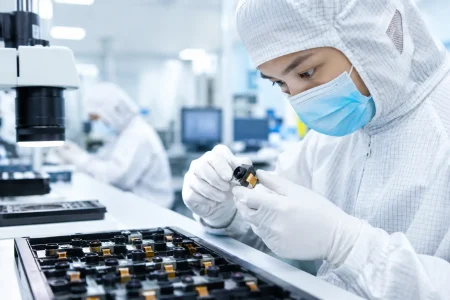
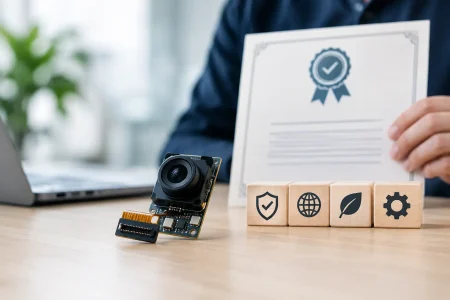
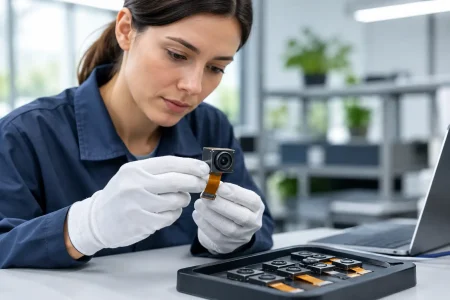
Supplier qualification should include more than a sample image. Confirm sensor availability, lens consistency, interface compatibility, module dimensions, operating-temperature expectations, and quality-control traceability. For commercial programs, ask how optical alignment is controlled across production lots and how quickly engineering changes can be validated. A custom module is only useful if it can be reproduced reliably after the pilot run.
SincereFirst supports this process with standard MIPI, USB, DVP, and FPC camera modules alongside custom sensor, lens, connector, and mechanical configurations. For teams moving from proof of concept to volume equipment, fast sample iteration and stable manufacturing control can prevent a camera decision from becoming a late-stage production risk.
The strongest agricultural vision system is usually not the one with the most expensive sensor. It is the one that consistently captures the specific evidence your algorithm needs, under real field conditions, and can be manufactured with the same performance from the first prototype through every deployed unit.