
A warehouse robot cannot wait for a cloud round trip to decide whether a pallet is blocking its path. A surgical visualization device cannot tolerate dropped frames when a clinician needs a clear view. These constraints define the future of edge imaging hardware: cameras are becoming compact perception systems that capture, process, interpret, and act close to the point of use.
For OEMs and system integrators, the shift is not simply toward higher-resolution sensors or more powerful AI processors. It is a system-level engineering challenge involving optics, sensor selection, interface bandwidth, embedded compute, thermal control, mechanical design, security, and manufacturing repeatability. The winning design will be the one that produces usable visual intelligence under real power, size, cost, and supply-chain limits.
Why the Future of Edge Imaging Hardware Is Local
Cloud vision remains valuable for fleet analytics, model training, centralized storage, and cross-site reporting. It is less suitable for every decision made by a camera-equipped device. Network latency varies, bandwidth is expensive at scale, and connectivity can be unavailable in factories, farms, vehicles, remote infrastructure, and clinical settings.
Edge imaging moves selected workloads closer to the sensor. A smart camera may perform image signal processing, object detection, barcode reading, anomaly screening, depth estimation, or image-quality checks locally, then send only events, metadata, or selected clips upstream. This reduces transmission demand and can improve response time while keeping sensitive image data within the device or local network.
The trade-off is straightforward: local intelligence adds design complexity. Processing requires memory, power, board area, and thermal headroom. Models must be optimized for the intended processor, and every update must be managed securely. Edge architecture is therefore not an automatic replacement for cloud processing. It is a decision about which data must be acted on immediately, which data must be retained, and where each workload can run most efficiently.
Sensor Choices Will Be Driven by Scene Requirements
Resolution remains a purchasing specification, but it does not independently determine system performance. A 4K sensor may provide useful inspection detail, yet it also increases data rate, storage requirements, processing demand, and heat. For a compact access-control terminal or mobile robot, a lower-resolution sensor with better low-light behavior and a faster frame rate may generate more dependable results.
Sensor selection should begin with the scene. Engineers need to define working distance, field of view, object speed, illumination type, required defect size, color accuracy, motion blur tolerance, and expected ambient light. Industrial inspection may need global shutter performance to prevent distortion on moving production lines. Security and smart-city devices may prioritize high dynamic range and low-light sensitivity. Medical and endoscope applications frequently place a premium on compact dimensions, color fidelity, controlled illumination, and stable image output.
Near-infrared sensitivity, polarization, multispectral imaging, and time-of-flight depth sensing will also become more common where conventional RGB images are not enough. These capabilities add information, but they also create integration questions. Different illumination sources, optical coatings, synchronization methods, and calibration processes may be required. The right imaging stack is application-specific, not a feature checklist.
Optics Become a Larger Part of AI Accuracy
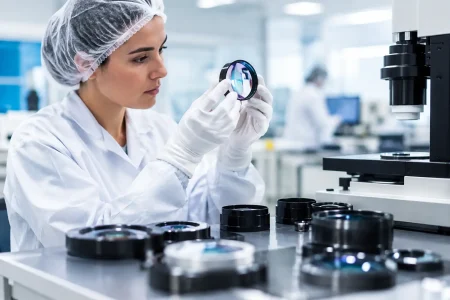
An AI model cannot recover detail that poor optics never delivered. Lens distortion, flare, focus drift, vignetting, chromatic aberration, and inconsistent illumination can all reduce detection accuracy before inference begins. As edge models become more capable, optical quality and calibration become even more commercially significant.
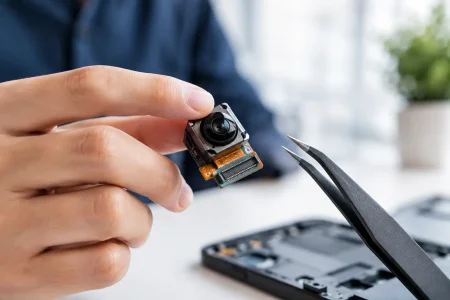
Compact devices will continue to demand smaller camera modules, but miniaturization must not compromise the image needed by the algorithm. This is especially apparent in endoscopes, robotics, and embedded medical equipment, where space is restricted and the target scene can be difficult to illuminate. A practical module design considers sensor format, lens stack height, focal length, aperture, depth of field, illumination geometry, and mechanical tolerance together.
Interfaces Must Match the Real Data Path
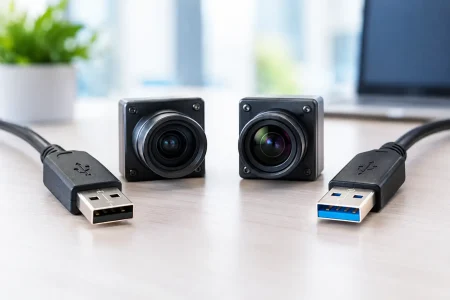
The camera interface is no longer a secondary procurement detail. It determines whether the host can receive and process frames without bottlenecks. MIPI CSI-2 remains a strong fit for compact embedded platforms because of its low power use and direct connection to many mobile and AI system-on-chips. USB camera modules offer broad compatibility and can simplify integration for industrial PCs, kiosks, laboratory equipment, and development platforms. USB 3.0 provides substantially more bandwidth than USB 2.0 when higher resolution or frame rate is required.
DVP interfaces still have a place in simpler embedded designs, while Ethernet-based camera architectures can suit longer cable runs and distributed industrial systems. There is no universal best interface. The correct choice depends on cable length, host capability, electromagnetic environment, resolution, frame rate, latency target, available I/O, and production cost.
Teams should validate the entire path early: sensor output, serializer or bridge if used, connector, cable, host receiver, memory bandwidth, ISP, AI accelerator, and application software. A module that works on a development bench can fail in production if connector retention, cable routing, power noise, or thermal conditions are treated as afterthoughts.
Compute Is Moving Closer to the Camera
The next generation of edge systems will increasingly combine image capture with dedicated ISP functions and AI acceleration. Some functions may sit in the host processor; others may move to an intelligent camera or a nearby compute board. The best partition depends on response-time requirements and the number of cameras in the system.
For example, a multi-camera automated guided vehicle may preprocess each stream locally, run perception models on a centralized edge processor, and transmit operational data to a fleet platform. A small inspection device may benefit from a camera module connected to a compact embedded board that performs all analysis on site. Both are edge imaging designs, but their compute distribution is different.
Model efficiency matters as much as accelerator performance. Quantized models, carefully selected input resolution, region-of-interest processing, frame skipping, and event-triggered capture can reduce power consumption without sacrificing the decision quality required by the application. Engineers should measure end-to-end latency rather than relying on advertised AI operations per second.
Thermal, Power, and Reliability Will Decide Production Success
Edge devices often operate where cooling is limited: sealed enclosures, mobile platforms, outdoor housings, handheld equipment, and miniature medical tools. Sensors generate heat, processors generate more heat, and high-power illumination can become the dominant thermal load. Heat can raise image noise, affect color consistency, reduce component life, and cause processor throttling.
This is why thermal design must begin during camera and compute selection. Evaluate the full duty cycle, not only a short test sequence. Consider ambient temperature, enclosure material, heat paths, PCB stack-up, component placement, illumination timing, and operating duration. Power budgeting deserves the same discipline, particularly for battery-powered devices that must balance inference frequency, illumination intensity, wireless transmission, and runtime.
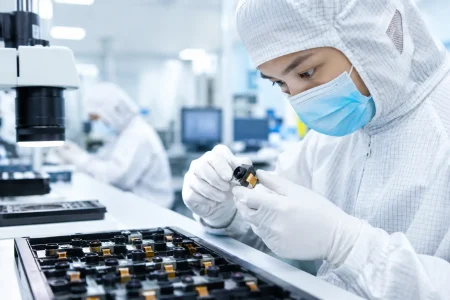
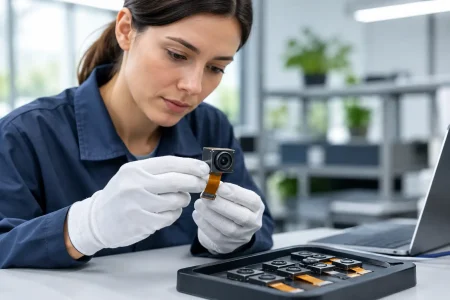
Manufacturing reliability also depends on details that are easy to overlook during prototyping. Lens alignment, adhesive curing, sensor cleanliness, flex-cable bending, connector mating cycles, electrostatic discharge protection, and image calibration procedures all affect yield and field performance. A qualified supplier should be able to support specification review, sample builds, validation changes, and repeatable volume production rather than merely shipping a camera module.
Security and Lifecycle Planning Cannot Be Added Later
As cameras become networked sensors and local AI endpoints, they expand the attack surface of industrial and commercial devices. Secure boot, authenticated firmware updates, controlled debug access, signed software, encrypted communications, and protected device credentials should be designed into the architecture. Privacy requirements may also favor local processing when images contain faces, patient information, or proprietary production data.
Lifecycle planning is equally practical. A device program may need stable supply for years, while image sensors, processors, and connectors can change status during that period. Teams should assess component availability, alternate options, revision control, test coverage, and second-source strategy before product launch. Lowest initial module cost is not always lowest program cost if a redesign is required after a short component lifecycle.
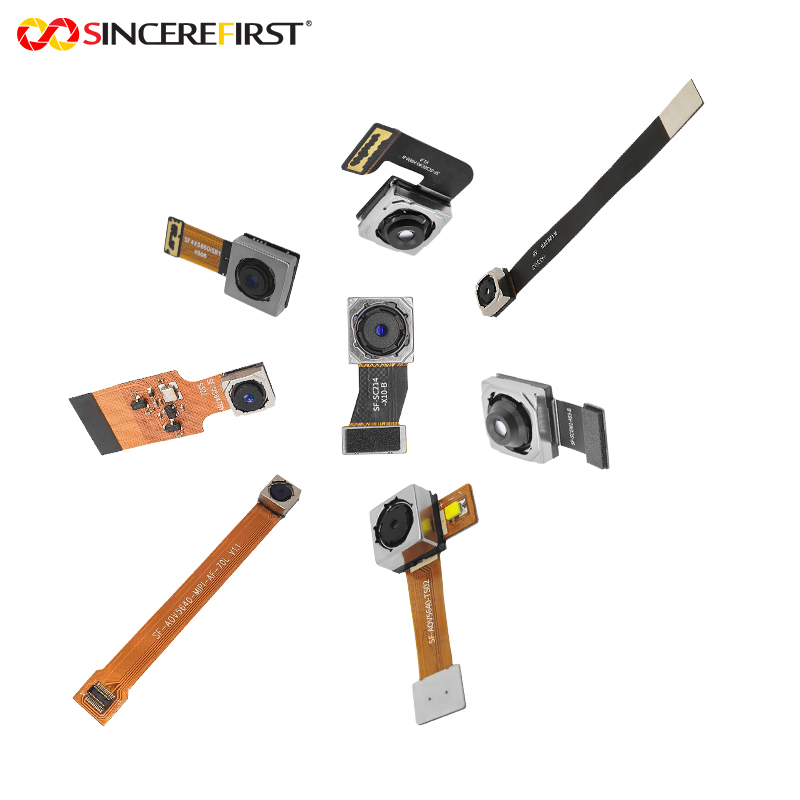
SincereFirst supports this type of development with standard and customized embedded camera modules, optical integration capability, rapid sampling, and scalable manufacturing for applications ranging from industrial automation to medical imaging and robotics.
Design for the Decision, Not Just the Image
The most useful question for an edge imaging project is not, “What camera has the highest specification?” It is, “What decision must this device make, under what conditions, and how consistently must it make it?” That question connects the optical image to the final commercial requirement.
Define the decision threshold early, test with representative scenes, and include poor lighting, vibration, reflective surfaces, motion, temperature variation, and real installation geometry. Then select the sensor, lens, interface, compute platform, and manufacturing process that can sustain that performance in volume. This approach gives intelligent devices something more valuable than a camera: dependable eyes built for the work they must do.