
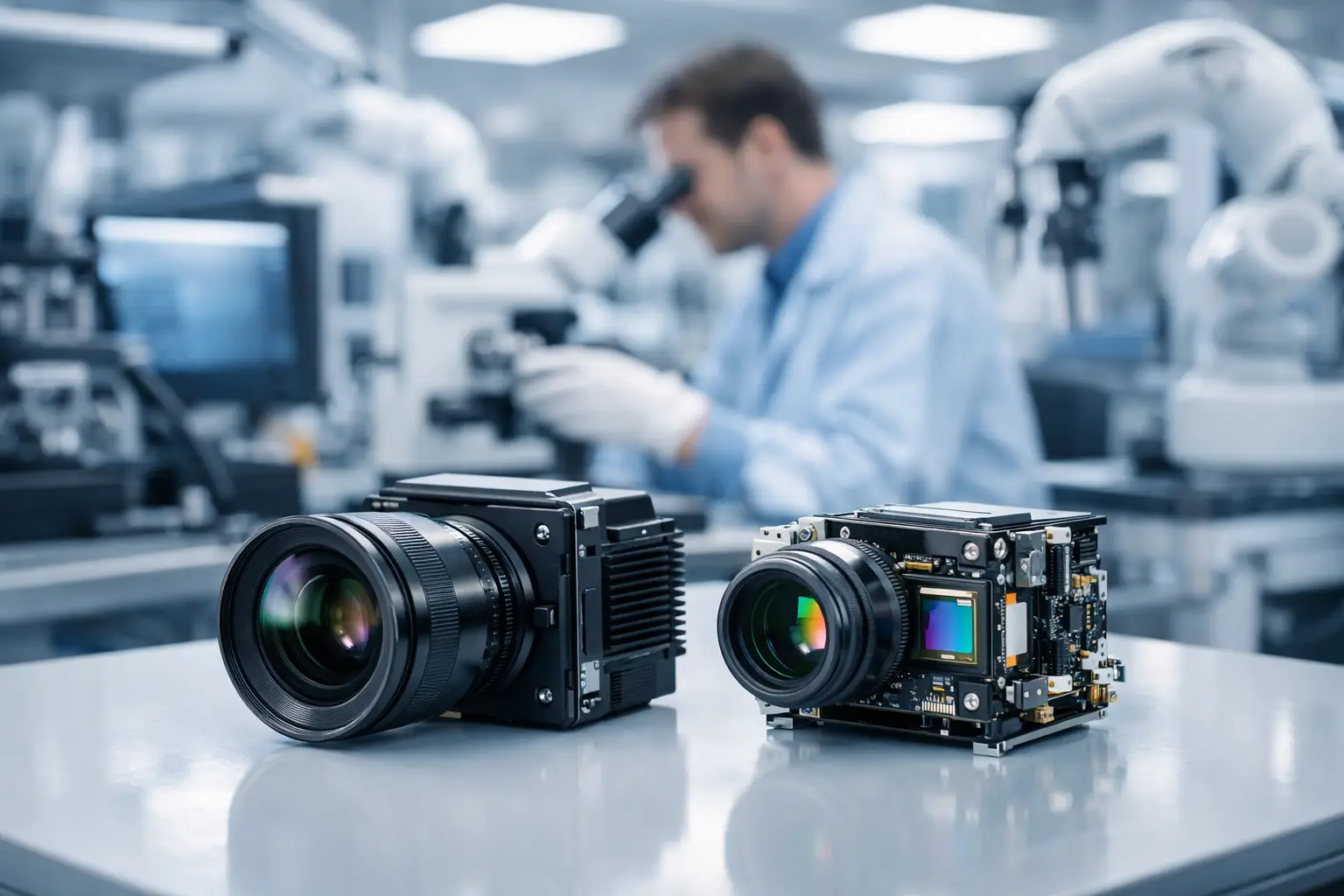
A camera module that performs well in a 20-piece engineering build can still fail at 20,000 units. The sensor may be available, but the lens holder may drift after reflow. Image tuning may look correct on one prototype, while a different lens lot changes shading and focus. For OEMs asking how to scale custom camera production, the answer is not simply finding more factory capacity. It is converting an imaging design into a controlled, measurable, repeatable manufacturing system.
Custom camera programs are especially exposed because performance depends on an optical, mechanical, electronic, and software stack. Resolution alone does not define success. Focus position, field of view, MTF, distortion, color consistency, interface stability, cable routing, thermal behavior, and assembly yield must hold within agreed limits from pilot build through volume shipment.
Start With a Production-Ready Camera Specification
Scaling begins before the first production order. A requirements document should define more than sensor model, resolution, and interface. It should establish the conditions under which the module will be accepted.
For a MIPI, USB, DVP, or FPC camera module, specify the target frame rate, pixel format, operating distance, illumination conditions, field of view, focus range, working temperature, power limits, and host platform. For machine vision applications, add motion conditions, exposure targets, trigger requirements, and allowable image defects. For medical or endoscope designs, dimensions, illumination uniformity, waterproofing expectations, biocompatibility considerations, and sterilization exposure may be equally important.
This level of definition prevents a common scaling problem: the supplier manufactures to a mechanical drawing while the customer expects a particular image result. Both parties need the same acceptance standard. Define golden samples, test charts, pass-fail thresholds, and inspection methods early. If image quality is evaluated by human judgment alone, production disputes become likely when volume increases.
Freeze What Must Be Controlled, Not Every Detail
A scalable specification does not mean locking every component prematurely. Some items should remain flexible when qualified alternatives are acceptable. Sensors, connectors, LEDs, flex circuits, and passive components can face supply constraints or end-of-life notices.
The practical approach is to identify critical-to-quality items. These are the components and dimensions that directly affect optical performance, electrical reliability, regulatory requirements, or mechanical fit. For example, a lens mount tolerance and sensor-to-lens distance may be tightly controlled, while an approved resistor source may be interchangeable. This distinction supports supply continuity without weakening the camera module’s functional baseline.
Design for Manufacturing Before Tooling Is Released
Design for manufacturing, or DFM, is where many custom camera projects either gain scale or inherit expensive problems. A module can be technically elegant and still be difficult to assemble consistently. Excessively tight tolerances, delicate flex routing, inaccessible test pads, and manual alignment steps can suppress yield long after development is complete.
Review the design with the manufacturing team before committing to fixtures, molds, or large material purchases. Examine the sensor PCB stack-up, lens barrel interface, shielding, adhesive process, connector placement, and final device installation. The goal is to reduce variation at the source rather than sort defects after assembly.
Active alignment deserves particular attention. If a lens must be positioned and fixed while the module is imaging a target, the process needs defined alignment equipment, curing controls, and verification criteria. The adhesive type, dispensing volume, curing time, UV exposure, and thermal profile can all affect final focus. A fast prototype method may be unsuitable for volume production if it relies heavily on technician judgment.
Build Test Access Into the Module
Production test should be designed alongside the camera, not added after the layout is finished. The module needs a reliable way to power up, communicate with the test fixture, and capture images under controlled conditions. Test pads, connector access, firmware configuration, and calibration data handling should all be considered during development.
A useful test plan generally covers electrical functionality, sensor communication, current consumption, image output, defective pixel criteria, focus or MTF performance, white balance behavior where applicable, and cosmetic inspection. The exact test depth depends on the application. A consumer accessory may prioritize throughput and visual quality, while an industrial inspection camera may require traceable performance records and tighter optical validation.
Scale Custom Camera Production Through Controlled Validation
Moving from samples to volume should be staged. Skipping directly from an engineering prototype to a large purchase order concentrates too much risk in one build. A better path uses engineering validation, design validation, and production validation builds, with clear learning objectives at each stage.
The engineering build confirms that the selected sensor, optics, PCB, and interface operate as intended. The design validation build checks whether the design meets the full application requirement across realistic conditions. The production validation build proves that operators, equipment, test fixtures, materials, work instructions, and quality controls can repeatedly produce conforming units.
At each stage, track yield by process step instead of reporting only final pass rate. Final yield can hide recurring weakness. If failures cluster around lens contamination, solder joints, flex damage, or image tuning, the manufacturing team needs to identify the root cause before volume ramps. Rework may be acceptable during early development, but it is not a scale strategy.
Pilot quantities depend on module complexity and application risk. A simple USB UVC module using established optics may move quickly. A compact medical imaging module, a side-view endoscope camera, or a custom low-light machine vision design needs more extensive process validation. The correct question is not, “How fast can we start mass production?” It is, “What evidence shows this process will remain stable after demand increases?”
Secure the Supply Chain Around the Optical Stack
Camera supply chains are not limited to image sensors. Lens assemblies, IR filters, voice coil motors, LEDs, FPCs, connectors, adhesives, shielding materials, and packaging can each delay production. A single long-lead component can stop a finished module line.
Before ramping, qualify sources for every critical component and confirm lead times based on the actual forecast, not a one-time sample requirement. Where practical, approve second sources or technically equivalent alternatives. This requires disciplined change control. Replacing a lens or IR-cut filter without revalidating image output can alter focus, color response, flare, or shading.
Material traceability is particularly valuable for industrial, medical, and security applications. Lot records make it possible to investigate field failures, isolate affected units, and maintain confidence when a component change is required. Traceability adds administrative work and cost, but it is often far less expensive than an uncontrolled quality event.
Make Quality Data Part of the Manufacturing Output
Inspection is necessary, but scalable quality comes from process control. Define what data must be recorded during production and how it will be reviewed. Depending on the module, this may include sensor lot, lens lot, assembly station, focus value, image test result, current draw, firmware version, and final inspection status.
Statistical process control is especially useful for dimensions and performance values that drift gradually. If a focus metric begins trending toward its lower limit, the team can correct alignment equipment or material handling before modules fail. If solder defects rise after a new PCB lot arrives, incoming inspection and supplier review can begin immediately.
The right level of data depends on the commercial risk. Full unit-level traceability may be justified for a regulated device or high-value industrial system. For a high-volume standard camera module, batch-level traceability with defined sampling may provide the better cost-performance balance. Quality systems should support the product’s actual failure consequences, not create paperwork with no decision value.
Treat Change Control as a Commercial Safeguard
Production rarely remains static. Sensors reach end of life, connector vendors revise materials, customers request a cable length change, and device firmware evolves. The risk is not change itself. The risk is an undocumented or insufficiently tested change entering production.
A formal engineering change process should define who approves changes, what validation is required, how old and new material are identified, and when the customer must be notified. Changes affecting optical path, sensor performance, interface timing, enclosure fit, or regulatory compliance deserve special scrutiny.
For OEM procurement teams, this is a major supplier qualification question. A camera manufacturer should be able to explain its revision controls, sample approval process, lot management, and notification practices. Price and capacity matter, but uncontrolled substitutions can cost far more than a small unit-price difference.
Choose a Partner That Can Scale Engineering With Output
The best manufacturing partner for a custom module is not always the factory with the largest stated capacity. The partner must connect prototype engineering to repeatable production. That means optical design knowledge, electronic integration capability, clean manufacturing practices, fixture development, image testing, supply-chain management, and responsive corrective action.
SincereFirst supports this model by combining custom camera development with scaled manufacturing experience across embedded imaging applications. For an OEM, the practical advantage is continuity: the team that understands the camera’s sensor, optics, interface, and application constraints can help establish the controls needed for a reliable ramp.
A successful production ramp is built through disciplined decisions made early: measurable specifications, manufacturable designs, validated processes, qualified materials, and data that reveals variation before it becomes a customer problem. When those foundations are in place, higher output becomes a controlled business decision rather than a gamble.