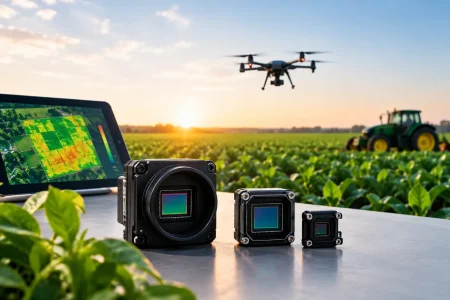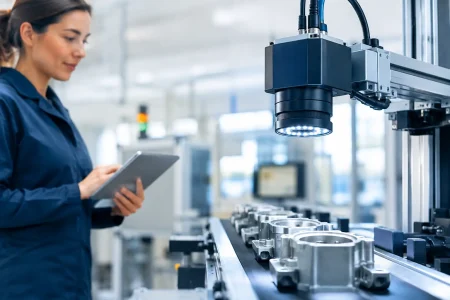

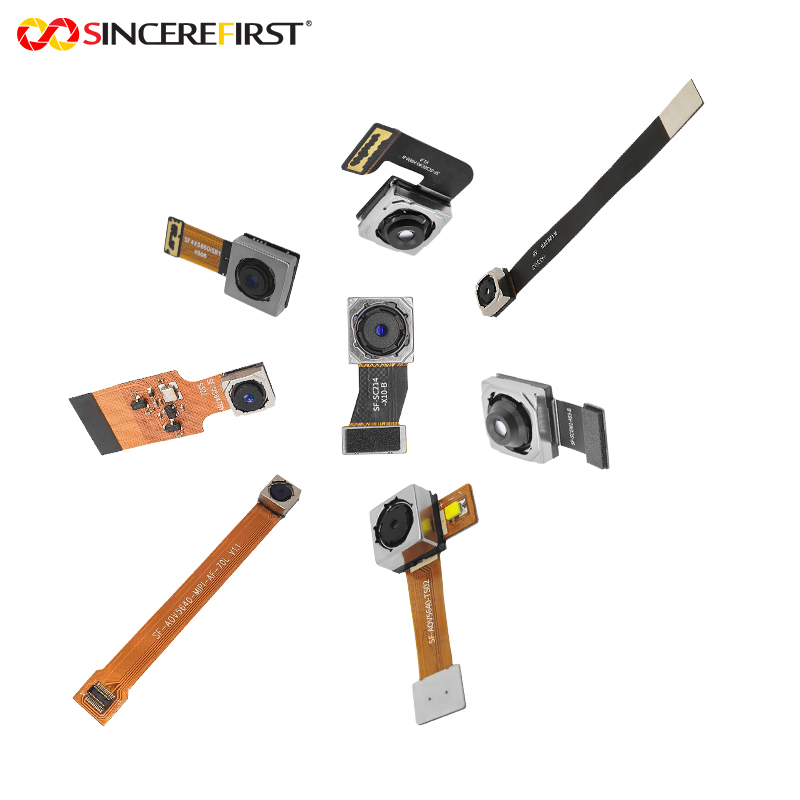
A camera that performs well in a lab can fail quickly in a vineyard, greenhouse, or open field. Dust, vibration, glare, low-angle sun, moisture, and uneven target distance all expose weak imaging decisions fast. That is why selecting an agriculture vision system camera is less about headline resolution and more about building an imaging subsystem that can survive real operating conditions while still delivering usable data.
For OEMs, integrators, and agricultural equipment developers, the camera is rarely a standalone part. It sits inside a broader machine vision pipeline that includes optics, illumination, ISP tuning, interface bandwidth, onboard compute, enclosure design, and production consistency. If one piece is mismatched, field performance drops and development time expands.
What an agriculture vision system camera needs to do
In agriculture, vision tasks vary widely. One system may identify crop rows for autonomous guidance, while another detects fruit maturity, checks plant spacing, reads barcodes on trays, or measures weed pressure for targeted spraying. The imaging requirement changes with the job, but the commercial expectation stays the same – stable output, repeatable integration, and scalability from prototype to production.
That creates a different buying standard than consumer imaging. A higher megapixel count is not automatically better if the frame rate drops, the sensor struggles in low light, or the lens cannot hold focus across temperature changes. In many agricultural devices, reliability under changing light is more valuable than maximum image size.
The most effective camera choice usually starts with three practical questions. What exactly must the system detect? At what distance and speed? Under what lighting and environmental conditions? These answers shape the sensor format, lens specification, shutter type, interface, and housing strategy more than any brochure spec does.
Sensor and optics decisions that matter most
The sensor is the core of the agriculture vision system camera, but it only delivers value when paired with the right optics and tuning. In outdoor applications, dynamic range is often a first-order requirement. A machine may need to image dark soil and bright reflective leaves in the same frame. If highlight clipping is severe or shadow detail disappears, downstream algorithms become unstable.
Global shutter is often the safer choice for moving equipment, robotic platforms, and high-speed sorting lines because it prevents rolling distortion. Rolling shutter can still be workable in slower or lower-cost systems, but motion artifacts need to be evaluated early, not after enclosure tooling is complete.
Pixel size also deserves more attention than many teams give it. Larger pixels can improve low-light sensitivity and reduce noise, which is useful for dawn, dusk, greenhouse, and shaded canopy conditions. Smaller pixels can support finer detail, but only if the lens, working distance, and processing pipeline can actually preserve that detail.
Lens selection is equally critical. A wide field of view may help row guidance, but it can introduce distortion that complicates measurement. A narrow field may increase detail on fruit or leaves, but coverage falls and mounting tolerances become tighter. Fixed-focus lenses are common in embedded systems, yet focus lock, temperature stability, and edge sharpness should be tested with the final mechanical stack, not with a bench sample alone.
Interfaces and system architecture
Camera performance on paper means little if the interface does not fit the host platform. Many agricultural devices operate on embedded processors where bandwidth, cable length, power budget, and software support are tightly constrained.
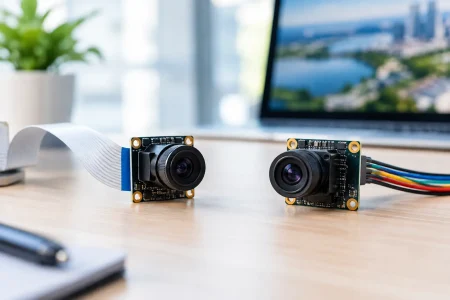
MIPI camera modules are a strong fit when the camera sits close to the processor and the design needs low latency, compact size, and cost-efficient embedded integration. USB camera modules are often easier for rapid development, external peripherals, and systems that benefit from UVC compatibility or simpler host connection. DVP still has a place in some legacy or cost-sensitive designs, though modern processing demands often push developers toward higher-bandwidth options.
This is where engineering trade-offs become practical rather than theoretical. A compact autonomous machine may need a small FPC or MIPI module integrated into a sealed housing. A desktop grading station may prefer USB3.0 for faster deployment and easier serviceability. Neither is universally better. The right answer depends on enclosure space, compute location, EMI conditions, and manufacturing volume.
Agriculture vision system camera design for difficult environments
Agriculture is unforgiving to poorly protected imaging hardware. It is not enough to specify a sensor and lens. The module, board-to-board connection, cable routing, and housing all need to account for shock, dust ingress, condensation, and temperature fluctuation.
Sunlight is one of the most underestimated problems. Outdoor light changes by the minute, and reflective plant surfaces can create flare and contrast loss. Anti-reflection lens treatment, sensor tuning, and controlled illumination can all help, but the system design has to consider them together. A strong ISP configuration with stable white balance, exposure behavior, and color reproduction often has more impact on machine vision consistency than teams expect.
In greenhouse systems, humidity and condensation may matter more than direct sunlight. In harvesting equipment, vibration and contamination can dominate. In drone or mobile robot platforms, size, weight, and power become major constraints. The phrase agriculture vision system camera covers all of these use cases, so the specification should never be copied from another project without validation.
Why customization often beats off-the-shelf selection
Standard camera modules can shorten early development, but agriculture applications often push beyond standard assumptions. The required lens angle may be unusual. The cable may need a custom length or connector orientation. The image tuning may need to prioritize leaf contrast, soil segmentation, or barcode readability rather than visual appearance.
This is where custom development changes the economics of the project. A module built around the correct sensor, interface, footprint, and optical stack can reduce adaptation work across the whole system. It can also improve manufacturability, because the camera is designed around the final device rather than forced into it.
For product teams working on OEM equipment, speed matters too. Fast sample turnaround helps validate field conditions before the rest of the platform is frozen. Once performance is confirmed, production quality and supply continuity become the next concern. A supplier that can move from prototype support to scaled manufacturing without changing process discipline is usually worth more than a cheaper sample source.
Evaluation criteria for buyers and engineering teams
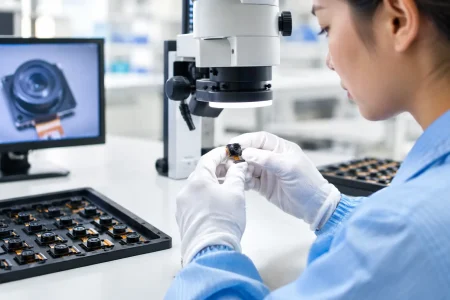
When qualifying an agriculture vision system camera, smart teams look beyond headline specs and ask how the module will behave across the full product lifecycle. They want image consistency lot to lot, not just one good sample. They want traceable manufacturing, not informal assembly. They want confidence that custom adjustments can be repeated in production.
In practical terms, evaluation should include sensor behavior in real field light, focus stability across temperature, cable reliability under movement, ISP tuning under target crop conditions, and host-side integration effort. It should also include commercial factors such as sample lead time, change control, manufacturing scale, and responsiveness when the design inevitably needs adjustment.
That is especially relevant for companies building products for North America and other export markets, where field support costs can erase any savings gained from choosing a low-credibility supplier. Camera modules are small parts, but imaging failures can stop an entire device from delivering value.
Matching the camera to the application
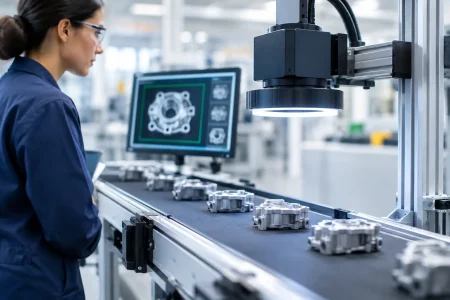
A row-following machine, a smart sprayer, and a produce inspection unit may all use machine vision, yet they do not need the same camera. Navigation systems often prioritize latency, dynamic range, and motion stability. Crop inspection may need better color fidelity and fine detail. Sorting and grading lines may require controlled illumination, high frame rates, and predictable optical geometry.
This is why application framing should happen before module selection. If the business target is a high-volume commercial product, then design-for-manufacturing has to be part of the imaging decision from the start. If the project is still proving agronomic value, a flexible development platform may be the better first step.
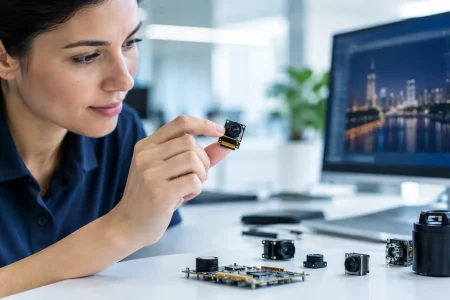
An engineering-led supplier can help narrow those choices by mapping use-case requirements to sensor families, module interfaces, lens configurations, and production paths. That is often more valuable than offering a long catalog with little guidance. SincereFirst operates in that space by combining embedded camera module supply with custom imaging development for equipment makers that need performance, speed, and manufacturing stability.
The strongest agriculture vision systems are not built by chasing the highest spec. They are built by choosing the camera that fits the agronomic task, the compute platform, the enclosure, and the production plan at the same time. If the image stays stable when the field gets dusty, the light turns harsh, and the machine starts moving, that is when the camera has done its job.