
A vision system that misses one defective part every few hundred cycles is not a small problem. On a production line, that miss becomes scrap, rework, warranty cost, or downtime. That is why buyers searching for the top USB camera modules industrial automation projects demand more than resolution on a datasheet. They need stable image output, predictable integration, and supply that can scale from prototype to volume production.
USB camera modules remain a practical choice in industrial automation because they shorten development time. UVC compatibility reduces driver work. USB 2.0 and USB 3.0 options fit different bandwidth and cost targets. Compact board-level designs make it easier to integrate imaging into robotic arms, inspection stations, kiosks, AGVs, and embedded HMI equipment. But not every module that works in a lab will hold up on a factory floor.
What makes top USB camera modules for industrial automation
The right module starts with application fit, not headline specs. In industrial automation, the best camera module is usually the one that balances image quality, latency, lighting tolerance, size, and integration effort.
Sensor choice matters first. If you need to read labels on moving cartons, global shutter is often the safer option because it reduces motion distortion. If the target is relatively static, such as operator verification or presence detection, a rolling shutter module may be enough and can lower cost. Resolution matters, but only when it supports the required field of view and defect size. A 13MP module sounds attractive, yet if the lens, processing, and lighting are not matched, that extra data can increase bandwidth and compute load without improving inspection yield.
Interface stability is just as important. USB 2.0 remains common for lower frame rate applications, compact embedded systems, and cost-sensitive designs. USB 3.0 is the stronger fit for higher resolution, faster frame rates, and lower compression requirements. In real deployments, this is less about chasing maximum speed and more about maintaining consistent image delivery under production conditions.
Then there is the optical stack. Lens selection, focus tolerance, field distortion, and IR filtering all affect whether the image is usable for machine vision. In many industrial programs, the module is not truly selected until the sensor, lens, housing constraints, illumination, and cable length have all been reviewed together.
The main types of USB camera modules used in automation
For most automation buyers, the market can be narrowed to a few practical categories.
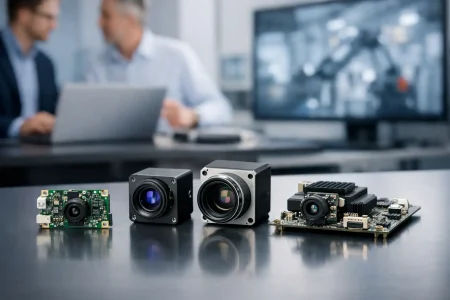
UVC USB modules are often the fastest to deploy. They simplify software integration and are useful for embedded Linux, Windows, and Android platforms where standard video class support reduces engineering time. They are a strong fit for HMI imaging, basic inspection, document capture, and operator monitoring.
USB3 vision-oriented modules are better suited for higher frame rate imaging, larger sensors, and more demanding inspection tasks. These are common in robotics, barcode reading at speed, and precision positioning. The trade-off is that the system design becomes less forgiving. Cable quality, host bandwidth, and thermal management matter more.
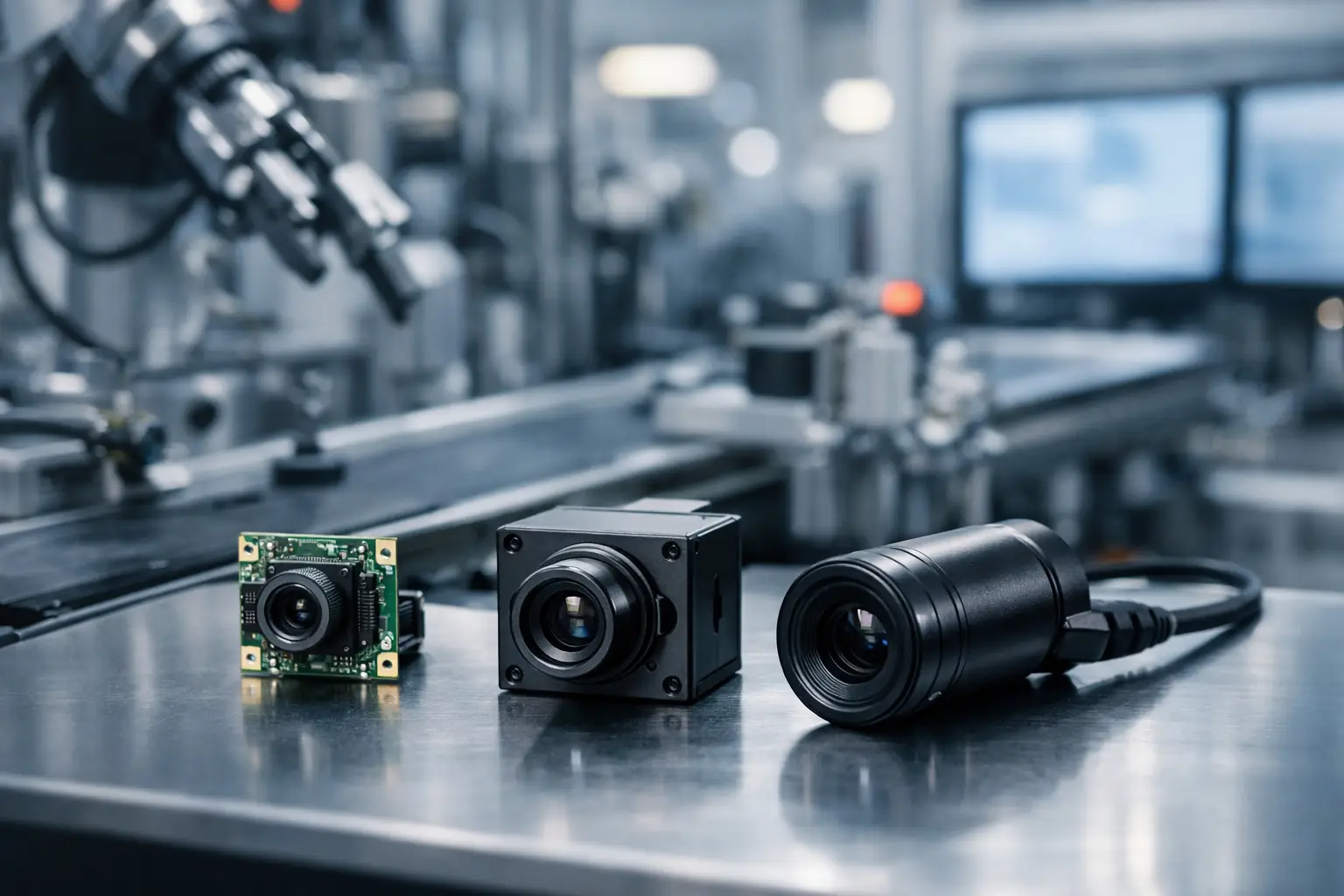
Miniature board cameras are ideal when space is limited. These modules are frequently integrated into compact industrial devices, autonomous systems, and custom enclosures. They save space, but they also place more pressure on the OEM to manage mechanical protection, EMI, connector reliability, and heat.
Autofocus modules can help in variable-distance applications, but fixed-focus modules are often preferred in industrial settings because they are simpler and more stable over time. If the working distance is controlled, fixed focus usually wins.
How to evaluate top USB camera modules industrial automation teams can trust
A procurement team may focus on cost and supply continuity, while the engineering team focuses on image quality and interface compatibility. Both are right. Industrial camera module selection only works when those priorities are evaluated together.
Start with the inspection task. Define the smallest feature that must be detected, the working distance, the object speed, and the lighting conditions. This determines whether you need global shutter, what resolution is actually useful, and what frame rate is required. Without this step, teams often overbuy sensor performance and underinvest in optics and illumination.
Next, review integration constraints. Consider board size, connector orientation, cable length, host processor, operating system, and mounting space. A module that performs well on a bench may become difficult inside a compact machine enclosure. USB is easy to adopt, but the surrounding system still needs disciplined electrical and mechanical design.
After that, evaluate production readiness. Ask whether the module supplier can maintain sensor consistency, lens alignment accuracy, and lot-to-lot quality. In industrial automation, a low-cost module with unstable sourcing can become very expensive once validation has been completed and the line is committed to that design.
Finally, assess customization capability. Many automation programs do not need a fully custom camera from day one, but they often need some adaptation – lens tuning, cable changes, IR cut options, mounting changes, firmware support, or housing refinement. A supplier that supports both standard modules and fast OEM adjustment usually shortens the path to deployment.
Key specifications that deserve more attention
Frame rate gets a lot of attention, but exposure control deserves equal focus. Fast-moving conveyors need short exposure times to avoid blur, which means lighting has to be strong enough to support that setting. If the lighting budget is limited, the highest frame rate on the spec sheet may not be realistic in your actual environment.
Dynamic range also matters. Industrial scenes often include reflective metal, dark plastic, backlit packaging, or mixed illumination. A camera that handles contrast poorly can force software compensation and increase false rejects. Similarly, low-light performance should be judged with the planned lens and aperture, not in isolation.
Latency and host load are easy to underestimate. For closed-loop automation, pick-and-place verification, or robot guidance, timing behavior matters as much as image quality. Compression can save bandwidth, but it may add delay or reduce image fidelity. The right balance depends on whether the system prioritizes speed, precision, storage efficiency, or CPU headroom.
Environmental reliability should never be treated as an afterthought. Vibration, dust, temperature variation, and 24/7 operation expose weak connectors, unstable focus settings, and poorly managed thermals. This is where industrial buyers separate consumer-derived modules from components prepared for commercial duty.
Where USB camera modules fit best in industrial systems
USB camera modules are especially effective in embedded automation equipment where compact design and fast integration matter. Common examples include defect inspection stations, robot end-of-arm vision, smart lockers, self-service equipment, automated microscopes, SMT verification, and compact AGV imaging.
They are also a practical choice for OEM products that need machine vision capability without the overhead of a larger external camera architecture. If the host system is nearby and the imaging distance is short, USB is often the fastest route from prototype to shipped product.
That said, USB is not always the answer. For long cable runs, highly distributed systems, or architectures that require deterministic industrial networking, other interfaces may fit better. This is a classic it depends decision. USB performs very well when the system is designed around its strengths instead of forcing it into a network layout it was not meant to serve.
Why supplier capability matters as much as module performance
The camera module itself is only one part of the buying decision. Industrial automation programs need repeatability over years, not only a successful pilot. A supplier should be able to support sensor selection, optical matching, sample tuning, validation feedback, and production scaling without resetting the project each time requirements change.
This is where an engineering-led manufacturer has an advantage. Teams benefit from access to multiple sensor options, USB 2.0 and USB 3.0 variants, lens configuration support, and OEM customization under one roof. For buyers building commercial products, this reduces qualification risk and speeds issue resolution. SincereFirst operates in this model, combining standard USB camera modules with tailored development for embedded and industrial imaging programs.
When reviewing suppliers, ask practical questions. Can they provide fast samples for testing? Can they adjust FOV, focus, connector type, or board dimensions? Can they support volume manufacturing with clean production control and stable component sourcing? These questions often determine whether the project stays on schedule.
Choosing the right module without overengineering
The strongest buying decisions are usually conservative, not flashy. Select the sensor that reliably resolves the target defect. Choose USB 3.0 only when bandwidth demands it. Use fixed focus when the working distance is controlled. Put budget into optics, lighting, and validation before paying for resolution you may not use.
For engineering teams and OEM buyers, the top USB camera modules for industrial automation are not defined by one perfect spec sheet. They are defined by fit – fit to the inspection task, fit to the embedded platform, fit to the production plan, and fit to long-term supply. When those pieces line up, the camera stops being a risk item and becomes a stable part of the machine.
If you are qualifying a module for a new automation product, the best next step is not chasing the biggest sensor. It is building a test setup that reflects your real line conditions and choosing a manufacturing partner that can refine the module with you as the product moves toward scale.