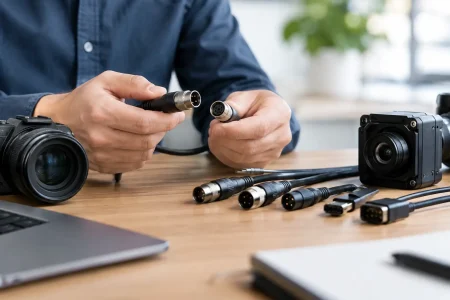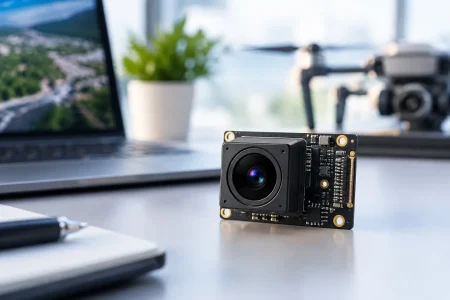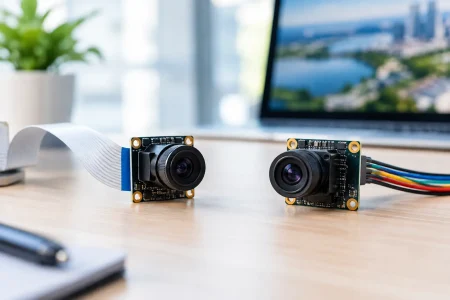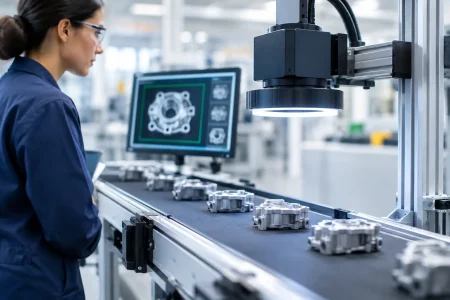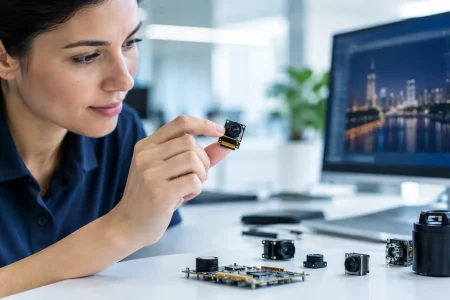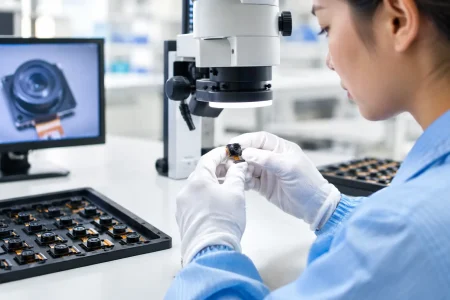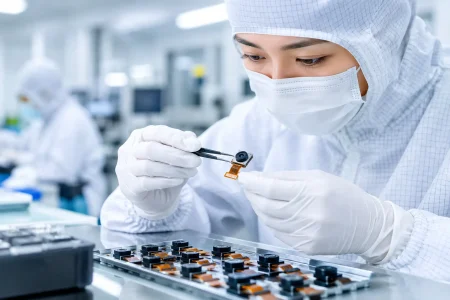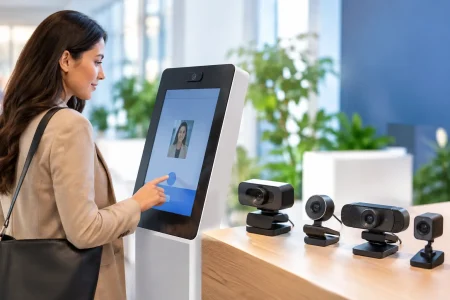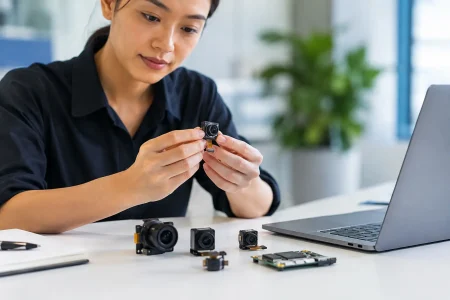

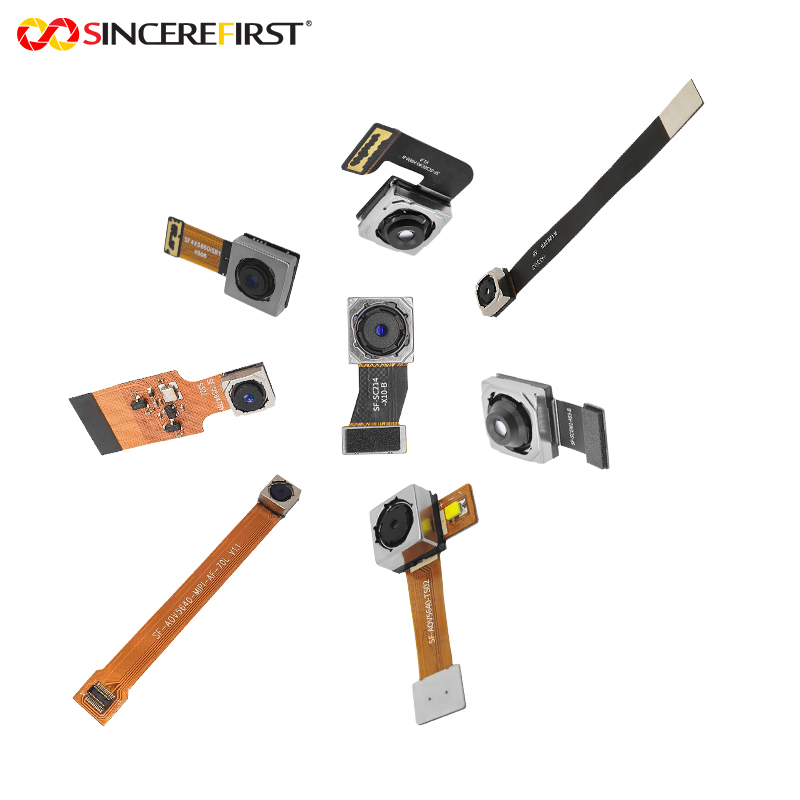
A camera module is no longer selected only for resolution, field of view, and frame rate. For product teams building robots, medical instruments, automated inspection equipment, and smart infrastructure, edge vision trends are changing the question: not “Can this camera capture an image?” but “Can this device make a reliable decision locally, within its power, cost, thermal, and latency limits?”
That shift moves camera selection earlier in the product-development cycle. Sensor behavior, lens performance, illumination, interface bandwidth, image signal processing, and AI workload are now tightly connected. A high-resolution module can still be the wrong choice if it increases compute demand, overheats the enclosure, or introduces delay that makes a mobile machine react too late.
Edge Vision Trends Are Moving Intelligence to the Device
Edge vision means acquiring, processing, and acting on visual data near the camera rather than sending every frame to a remote server. The cloud still has a role in fleet management, model training, centralized storage, and difficult exception review. But local processing is becoming the preferred path when an application requires immediate response, privacy protection, continuous operation, or lower network cost.
For an industrial robot, local inference can identify a misplaced component before the robot reaches the next motion step. For a patient-monitoring device, it can extract an approved visual event without transmitting a continuous video stream. For a traffic system, it can classify vehicles at the roadside rather than relying on a connection that may be congested or unavailable.
This is not a one-size-fits-all architecture. Some designs use an intelligent camera with an integrated processor. Others connect a compact MIPI camera module to an application processor, NPU, FPGA, or dedicated vision controller. USB camera modules remain practical where integration speed and standardized host connectivity matter more than minimum power consumption. The right architecture depends on where the system can tolerate latency, heat, component cost, and engineering complexity.
The Camera Is Becoming Part of the AI Pipeline
Machine vision performance begins before a frame reaches an AI model. If the image contains motion blur, clipped highlights, rolling-shutter distortion, poor focus, or excessive noise, inference accuracy falls regardless of how advanced the model is. This is why product teams are increasingly specifying imaging systems around the target decision rather than around a sensor data sheet alone.
Resolution Must Match the Smallest Critical Detail
More pixels are useful only when the lens, working distance, illumination, processor, and model can use them. A warehouse robot identifying pallet locations may benefit more from a wide field of view and stable exposure than from a very high-resolution stream. A printed circuit board inspection system may need high pixel density because a small solder defect occupies only a few pixels.
The practical requirement is to calculate pixels on target. Define the smallest feature that must be detected, the required confidence level, the camera distance, and the acceptable field of view. Then select sensor resolution and lens focal length together. Over-specifying resolution raises bandwidth, memory use, storage, and AI inference cost. Under-specifying it can force a redesign after field testing.
Global Shutter Gains Ground Where Motion Matters
Rolling shutter sensors remain efficient and cost-effective for many fixed or slow-moving scenes. They work well in document capture, access control, stationary inspection, and numerous consumer smart devices. However, fast motion can bend, skew, or partially expose objects because image rows are sampled at different moments.
Global shutter captures the full frame at the same instant, making it a stronger choice for robotic picking, high-speed manufacturing, drones, moving vehicles, and handheld medical devices. The trade-off can include sensor cost, power consumption, pixel size, or low-light behavior, depending on the sensor family. Teams should evaluate actual scene motion and illumination instead of treating global shutter as an automatic upgrade.
High Dynamic Range Is Becoming an Application Requirement
Many edge systems operate outside controlled lighting. A delivery robot travels from shadows into direct sunlight. A vehicle camera faces headlights at night. An industrial inspection camera sees reflective metal beside dark plastic. Standard exposure control may preserve one region while losing critical information in another.
High dynamic range sensor modes, multi-exposure techniques, controlled LED illumination, and well-designed optics can preserve usable detail across a broader brightness range. Yet HDR also introduces design choices. Multi-exposure capture can create artifacts in moving scenes, and aggressive tone mapping can alter the visual features expected by an AI model. Image tuning should be verified with the final model, lighting, and enclosure, not in isolation.
Low Latency Is a System Budget, Not a Camera Specification
A camera’s advertised frame rate does not equal system response time. The real latency budget includes exposure time, sensor readout, interface transfer, image signal processing, memory buffering, AI inference, decision logic, and actuator response. At 30 frames per second, a new frame begins only every 33 milliseconds. Add long exposure, multiple buffers, and inference time, and a seemingly fast system can become unsuitable for closed-loop control.
For safety-adjacent and motion-control applications, define a maximum time from scene event to system action. Then assign a budget to each stage. Short exposure may reduce blur but increase sensor noise. Lower resolution may accelerate inference but reduce detection accuracy. A faster interface may require a different host platform. These are engineering trade-offs that must be measured on production-intent hardware.
MIPI CSI-2 is frequently selected for compact embedded systems because it supports high bandwidth with low power and direct integration to mobile and embedded processors. USB 3.0 is often attractive for industrial PCs, rapid prototypes, and systems that benefit from standardized cabling. The interface should be chosen for cable length, electromagnetic environment, host availability, expected frame rate, and production serviceability, not only peak bandwidth.
Power and Thermal Design Are Limiting AI Ambition
As visual models move onto devices, heat has become one of the most common constraints in compact products. The image sensor, ISP, processor, memory, and illumination all add thermal load. In a sealed enclosure, elevated temperature can increase image noise, reduce LED lifetime, throttle the compute platform, and affect mechanical reliability.
A useful edge design reduces data and compute before they become a problem. This may mean using region-of-interest capture, lower frame rates during idle periods, event-triggered operation, optimized model quantization, or a sensor mode tailored to the task. It may also mean placing inference on a dedicated accelerator instead of a general-purpose CPU.
Thermal validation needs realistic conditions: maximum ambient temperature, continuous operation, final enclosure materials, power adapters, illumination duty cycle, and the intended AI workload. Bench tests at room temperature often produce misleading confidence. A camera module that performs well in a short laboratory test may behave differently after hours inside a compact outdoor or industrial product.
Privacy and Cybersecurity Are Shaping Camera Requirements
Local processing can reduce the amount of video that leaves a device. That is a substantial benefit for healthcare, workplace safety, retail analytics, and access-control applications. Some systems can send only metadata, alerts, anonymized counts, or tightly controlled image crops rather than full video streams.
Privacy is not guaranteed merely because inference runs at the edge. Product teams still need policies for image retention, diagnostic logs, remote support access, user consent, and incident response. Security requirements also extend to camera firmware, host drivers, update mechanisms, device identity, and physical access to connectors or debug ports.
For OEMs, this creates a supplier qualification issue. A camera module must be electrically and mechanically compatible, but it also needs stable documentation, traceable component control, consistent firmware behavior, and a clear change-management process. An unannounced sensor or lens substitution can affect image tuning and model accuracy across an installed fleet.
Customization Is Shifting From Optional to Strategic
Standard camera modules accelerate early prototypes, but production edge vision products frequently need targeted customization. Board shape, FPC length, connector orientation, lens holder height, focus position, IR-cut configuration, LED placement, shielding, and mounting features can all determine whether an imaging system fits its final enclosure and maintains stable image quality.
Optical customization matters just as much. A lens selected for a sample setup may show corner softness, flare, distortion, or focus drift when installed behind a protective cover window. The cover material, coating, angle, and spacing should be considered as part of the optical stack. In endoscope, medical, and compact inspection systems, diameter constraints make this integration work especially demanding.
A capable manufacturing partner should support the progression from sample evaluation to engineering validation, pilot build, and volume production without losing control of critical specifications. SincereFirst approaches this work through camera module, optical component, and customized imaging system development, helping OEM teams align module design with integration and manufacturability requirements early.
What Product Teams Should Validate Before Volume Production
The most effective validation plans use representative scenes rather than generic image charts alone. A security camera should be tested against its expected night lighting, motion, and weather conditions. An agricultural vision device should see dust, vibration, changing daylight, and real crop color variation. A factory inspection camera should evaluate actual materials, cycle times, and surface reflections.
Before releasing a design, confirm four connected areas: image quality at the task distance, end-to-end latency under peak load, thermal behavior in the final enclosure, and supply consistency across production lots. Also assess calibration needs, autofocus or fixed-focus stability, cable strain relief, electromagnetic compatibility, and the availability of replacement components over the product lifecycle.
The strongest edge vision systems are not built around the highest specification on a camera data sheet. They are built around a repeatable decision in a real operating environment. Start with the event the device must recognize, then engineer the sensor, optics, interface, compute path, and manufacturing controls to make that decision dependable at scale.