
A thermal imager can be specified correctly on paper and still fail the product program. The reason is usually not the detector alone. Thermal camera integration depends on the relationship between sensor format, lens performance, mechanical stability, processing bandwidth, calibration method, and the actual decision the device must make. For OEMs building industrial equipment, security products, robots, medical instruments, or smart infrastructure, that relationship determines whether thermal data becomes a dependable feature or an expensive source of false alarms.
Unlike visible-light imaging, thermal design begins with a different question: what temperature contrast must the system identify at a defined distance, through a specific field of view, under changing ambient conditions? The answer drives component selection long before the housing design is complete.
Start Thermal Camera Integration With the Use Case
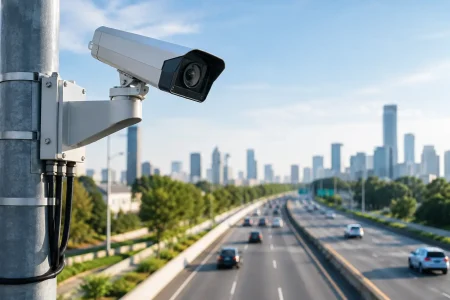
A thermal module intended to detect a person at a site perimeter does not need the same optical design, temperature accuracy, or image processing as a module that monitors overheating bearings on a production line. Treating both as a generic thermal camera requirement creates avoidable cost and performance gaps.
For presence detection, relative thermal contrast may be sufficient. A non-radiometric module can support occupancy sensing, perimeter monitoring, or human and vehicle detection when the system needs to recognize heat patterns rather than report an exact temperature. For predictive maintenance, electrical inspection, and process monitoring, radiometric output is often the better fit because every pixel can be mapped to temperature data after appropriate calibration.
The target size and working distance matter just as much. A wide-angle lens can monitor a large area, but spreads the target across fewer pixels. A narrow field of view improves spatial detail at distance, while reducing the scene covered. The practical requirement is not simply resolution. It is the number of pixels available on the smallest defect, hot spot, or object that must be detected.
Before selecting a module, define the operating distance, field of view, minimum target size, temperature range, allowable measurement error, frame rate, ambient environment, and required response time. This specification turns a broad request for thermal imaging into an engineering requirement that can be tested.
Select the Sensor and Optics as One System
Most compact industrial thermal products use uncooled microbolometer sensors, commonly operating in the long-wave infrared band. These sensors are well suited to applications where low power, compact size, and practical product cost are priorities. Their performance still varies materially by array resolution, pixel pitch, thermal sensitivity, frame rate, shutter behavior, and output format.
Higher resolution is valuable when the device must inspect smaller features, cover a wider area, or support image analytics. It also raises data throughput, processing demand, storage requirements, and cost. In a compact handheld tool or battery-powered device, a lower-resolution core with carefully chosen optics may deliver a better commercial result than an oversized sensor that pushes power and enclosure limits.
Lens selection requires equal discipline. Thermal optics use materials that transmit infrared energy, not the glass typically used in visible cameras. The lens must match the sensor’s spectral band and active area while controlling distortion, focus shift, stray radiation, and edge performance. A lens that appears acceptable in a central image crop can create measurement inconsistency near the edge of a radiometric scene.
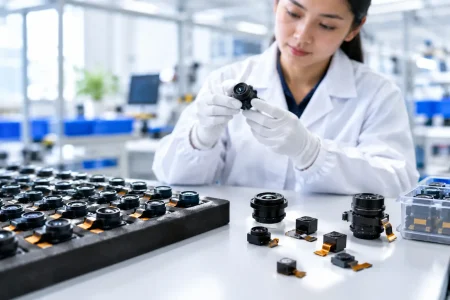
The mechanical interface between lens and sensor also deserves attention. Small changes in spacing, tilt, or housing stress can affect focus and repeatability. For high-volume production, the optical stack needs tolerances that the factory can inspect and maintain, rather than a prototype-only adjustment process.
Resolution Is Not the Same as Detection Performance
A 640 × 512 sensor may provide more scene detail than a 256 × 192 sensor, but it is not automatically the right choice. Detection performance depends on lens focal length, distance, contrast, environmental conditions, algorithm design, and the detection criterion. Fog, rain, hot backgrounds, reflective surfaces, and partial occlusion can all reduce usable contrast.
Engineering teams should validate the system using representative targets in representative conditions. Lab imagery is useful for module evaluation. Field testing is what confirms whether the finished device can identify the condition the customer cares about.
Build the Electrical and Processing Architecture Early
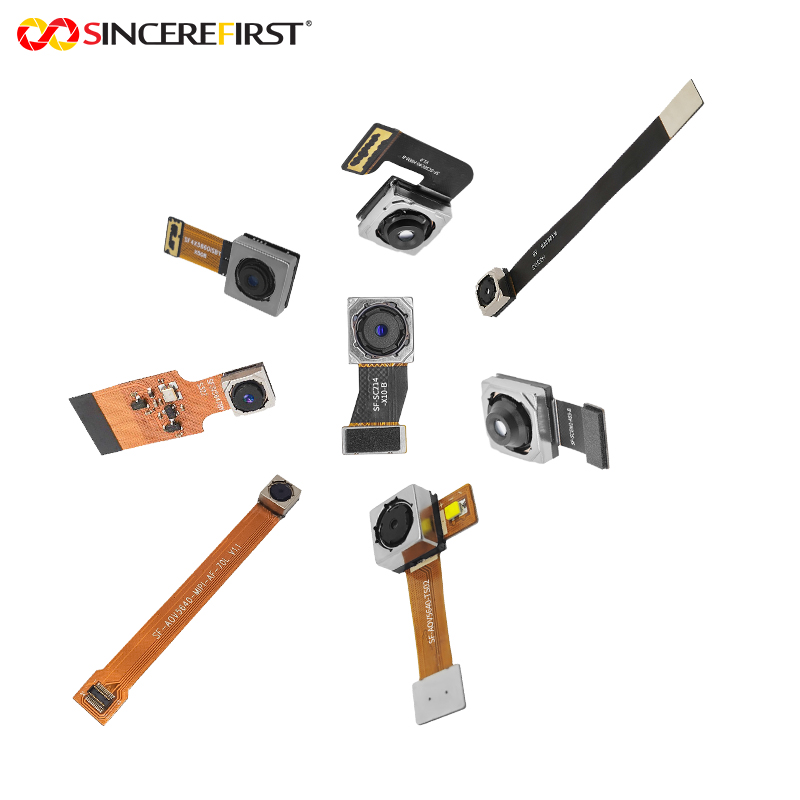
Thermal modules are available with interfaces such as MIPI CSI-2, USB, Ethernet, LVDS, or digital parallel outputs depending on the selected core and system architecture. Interface selection affects not only connector choice but also processor selection, cable length, electromagnetic compatibility, power design, and firmware complexity.
MIPI CSI-2 is often appropriate for compact embedded products where the module sits close to an application processor. USB can simplify evaluation and support external devices, while Ethernet is practical for distributed industrial systems that need longer cable runs or networked deployment. There is no universal best interface. The correct choice depends on the host platform, image latency, installation topology, and expected production configuration.
Thermal output also requires deliberate image pipeline design. Raw thermal data may need non-uniformity correction, bad-pixel handling, temporal filtering, automatic gain control, color palette mapping, overlay graphics, and compression. A display-oriented image may need aggressive contrast optimization, while an analytics engine may need stable 14-bit or 16-bit data with minimal transformation.
If the device uses AI inference, determine whether the model needs thermal-only data, visible and thermal fusion, or thermal data paired with other sensors. Fusion can improve situational awareness, especially in low light, but it adds synchronization, registration, optical alignment, and compute requirements. It should be adopted because it solves a defined detection problem, not because it makes a specification sheet look more advanced.
Calibration Determines Whether Temperature Data Can Be Trusted
Radiometric thermal products require more than a sensor with temperature output. The system must account for factors that influence apparent temperature, including emissivity, reflected temperature, distance, humidity, optical transmission, and the target surface itself. A matte painted component and a polished metal surface can produce very different readings even when their actual temperatures are similar.
Non-uniformity correction is another central consideration. Uncooled thermal sensors can drift as their internal temperature changes. Many systems use a shutter-based correction event to refresh the image and maintain consistency. This may briefly interrupt video, create an audible click, or affect time-critical workflows. Shutterless approaches can reduce interruption, but their performance depends heavily on sensor behavior and compensation algorithms.
For applications that require alarm thresholds, define whether the threshold is based on apparent temperature, compensated temperature, or relative change from a baseline. In many industrial monitoring deployments, trend detection is more reliable than one absolute number. A bearing that rises steadily above its normal operating profile can be actionable even when surface emissivity limits absolute accuracy.
Design the Module Into the Product, Not Just the Enclosure
Thermal camera integration often encounters problems after the module has been selected: heat from processors shifts internal conditions, a protective window attenuates infrared transmission, cable routing introduces noise, or a tight enclosure creates mechanical stress. These are product-level issues, so the module supplier, mechanical team, electronics team, and firmware team should align early.
The front window is especially important. A standard transparent cover may be opaque in the long-wave infrared spectrum. The protective material, coating, thickness, mounting method, and cleanliness standard must be selected for thermal transmission and environmental durability. Outdoor products also need to address water, dust, condensation, solar loading, and lens contamination.
Power behavior should be evaluated across startup, correction cycles, peak processing load, and low-temperature operation. If the product is portable, battery runtime must reflect the entire system: sensor, processor, display, communications, storage, and any active heating or cooling elements. The thermal module is only one contributor to the energy budget.
Move From Prototype to Repeatable Production
A demonstration unit proves that a concept is possible. A commercial program must prove that every build can meet the same optical, electrical, and functional criteria. This is where supplier capability matters as much as sample image quality.
A qualified manufacturing plan should define incoming inspection, lens and sensor alignment controls, electrical testing, image-quality checks, calibration verification where required, traceability, and final functional inspection. For customized modules, teams should also confirm connector retention, flex routing, mechanical datum control, and the availability of long-lead components before design freeze.
SincereFirst supports OEM camera development with an engineering-led approach to module selection, mechanical adaptation, interface integration, and scalable manufacturing. For product teams, early engagement is most valuable when the thermal requirement is still connected to the full device architecture, not reduced to a last-minute request for a camera footprint.
The strongest next step is to build a short validation plan around real targets, real distances, and real environmental conditions. It gives engineering, procurement, and manufacturing teams a shared basis for selecting a thermal imaging design that can perform reliably long after the prototype leaves the lab.