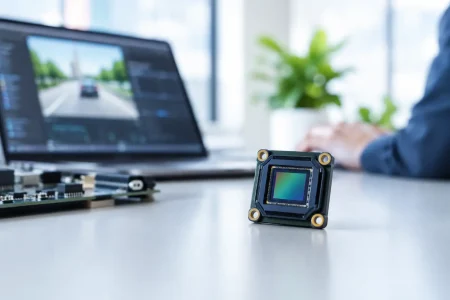

A conveyor can be running at full production speed, a robot arm can be changing direction, and an inspection camera can still need to read a tiny code or measure a part edge within a few pixels. That is when to choose global shutter sensors: when motion must be captured as a single instant, rather than assembled line by line over time.
For OEMs and system integrators, this is not simply a sensor preference. The shutter architecture affects image geometry, lighting design, processing requirements, module cost, and whether a vision system remains reliable outside the lab. A global shutter can solve motion artifacts that software cannot fully correct, but it is not automatically the best choice for every embedded camera design.
What a Global Shutter Changes
A global shutter sensor exposes every pixel at the same time. At the end of the exposure, the full image represents one shared moment. If a moving object crosses the field of view, its vertical edges remain vertical, its shape remains proportionate, and spatial measurements remain meaningful.
Most rolling shutter sensors work differently. They expose and read rows sequentially from the top of the image to the bottom. This is efficient and widely used in compact, cost-sensitive camera modules. However, when either the target or camera moves quickly, each row is recorded at a slightly different time. The resulting image can show skewed parts, bent edges, stretched features, partial LED illumination, or warped text.
The difference becomes decisive when image data drives an automated decision. A distorted consumer video frame may be acceptable. A distorted frame used to reject a good part, guide a robot gripper, or assess a surgical tool position is a process risk.
When to Choose Global Shutter Sensors in Machine Vision
Choose a global shutter when the scene contains fast, unpredictable, or precisely measured motion. The key question is not merely, “Is the object moving?” Nearly every real-world object moves. The question is whether motion during readout changes the image enough to compromise detection, measurement, decoding, or control.
High-Speed Conveyor Inspection
Production lines are a primary use case. Packaging, electronics, food containers, pharmaceutical products, and machined parts may move continuously beneath a camera. A rolling shutter can turn circular features into ovals, shift label positions, or make a Data Matrix code harder to decode as speed increases.
A global shutter captures the product position consistently across the full frame. That supports more dependable defect inspection, OCR, barcode reading, dimensional checks, and presence verification. It also reduces the amount of compensation required in vision algorithms, which can simplify validation and shorten commissioning time.
Exposure time still matters. Global shutter does not freeze motion by itself. A short exposure and sufficient illumination are required to prevent motion blur. In a well-designed system, high-intensity strobed lighting is synchronized with the global exposure, producing a sharp frame without forcing excessive gain.
Robot Guidance and Pick-and-Place
For robotic guidance, geometry is often more valuable than visual appearance. A robot may locate randomly oriented parts on a moving belt, verify a bin-pick position, or track an end effector. If rolling shutter distortion shifts an edge or changes the apparent angle of a component, the calculated pick coordinates can be wrong.
Global shutter sensors are especially appropriate when the camera is mounted on a moving robot, gantry, AGV, or handheld inspection device. Camera motion creates the same rolling shutter risk as target motion. A stable image during acceleration, vibration, and direction changes gives the vision stack a more reliable foundation.
This is particularly relevant for compact MIPI and USB camera modules integrated into robot controllers and edge computing platforms. Interface selection should follow the processing architecture: MIPI CSI-2 can suit tightly integrated embedded systems, while USB 3.0 can simplify higher-bandwidth industrial camera connections and rapid prototype evaluation.
Precision Metrology and Optical Measurement
If a camera measures gaps, diameters, alignment, hole position, or component orientation, distorted geometry is unacceptable. Global shutter capture preserves the spatial relationship between features within a frame, helping maintain measurement repeatability while parts are in motion.
That said, shutter type is only one part of metrology performance. Lens distortion, focus stability, mechanical mounting, calibration method, working distance, and pixel resolution can have an equal or greater effect on final accuracy. A global shutter sensor should be specified as part of an imaging chain, not treated as a complete measurement solution.
LED, Display, and Structured-Light Applications
Global shutters also have an advantage when illumination is pulsed or synchronized. In rolling shutter systems, short strobe pulses can expose only a portion of the frame if timing does not match the row-by-row scan. This may appear as bright and dark bands or uneven illumination.
A global shutter is better suited to controlled strobe imaging, structured-light projection, and inspection of LED indicators or displays. It enables the system designer to synchronize exposure, light pulse, projector pattern, and trigger input around one known capture event. For 3D vision and high-speed inspection, that timing control is often central to repeatable results.
Applications Where Global Shutter Is Usually Worth the Premium
Global shutter modules are commonly justified in industrial automation, logistics, robotics, traffic monitoring, smart-city infrastructure, laboratory instruments, and medical imaging equipment. They are also valuable in industrial endoscopes, where a moving probe or vibrating inspection target can otherwise create warped images in narrow, difficult-to-light spaces.
In medical and diagnostic devices, the selection must be evaluated carefully. Motion fidelity can be essential for imaging moving instruments or anatomy, but low-light sensitivity, color performance, heat constraints, module size, and regulatory design controls may carry equal weight. The best sensor is the one that supports the full clinical or device requirement, not merely the fastest shutter architecture.
When a Rolling Shutter Is the Better Engineering Choice
A global shutter is not a universal upgrade. For static or slow-moving scenes, a modern rolling shutter sensor can deliver excellent image quality at a lower cost and with a wider selection of high-resolution options. This can make it the more practical choice for access control terminals, document cameras, fixed security views, smart appliances, telehealth peripherals, and low-motion monitoring systems.
Rolling shutter sensors may also offer advantages in pixel size, low-light performance, resolution, power consumption, and availability, depending on the sensor family. If a product needs very high resolution, operates with stable mounting, and does not perform time-critical measurement, those trade-offs can favor rolling shutter.
A useful engineering test is to capture representative images at the maximum expected motion, not the average motion. Test worst-case conveyor speed, robot acceleration, vibration, illumination pulse width, and target distance. If distortion is visible but does not affect the application outcome, rolling shutter may remain suitable. If it changes a measurement, decode rate, or machine decision, global shutter becomes the safer path.
Sensor Selection Must Include the Full Camera Module
Selecting a global shutter sensor is only the first specification step. The module must deliver the sensor’s potential through the correct optics, electronics, mechanics, and data interface.
Resolution should match the smallest feature that must be detected at the required field of view. Frame rate must accommodate line speed and inspection coverage. Pixel size, quantum efficiency, and noise performance influence how much light is needed to achieve the short exposures required for sharp motion capture. Lens selection determines field coverage, distortion, depth of field, and image uniformity.
Trigger capability is equally important in industrial designs. Hardware trigger input, flash or strobe output, fixed exposure control, and stable frame timing help synchronize the camera with encoders, PLCs, lights, and robot controllers. For compact embedded products, board dimensions, connector orientation, cable length, EMI performance, and thermal behavior should be reviewed early, before enclosure tooling is finalized.
A supplier should be able to discuss these requirements at module level rather than provide only a sensor data sheet. SincereFirst supports this approach with standard and custom camera module development, combining sensor selection, optical matching, interface design, and manufacturing validation for volume deployment.
A Practical Decision Framework
Start with the consequence of image distortion. If the camera is recording general visual information, rolling shutter may be sufficient. If it is controlling movement, inspecting production quality, measuring geometry, or reading codes at speed, global shutter deserves serious consideration.
Then define the operating envelope: target speed, camera speed, working distance, required field of view, illumination conditions, desired frame rate, and acceptable blur. These inputs reveal whether the project needs global capture, short strobed exposure, or both.
Finally, compare total system cost rather than sensor price alone. A lower-cost rolling shutter module can become expensive if it causes false rejects, missed defects, algorithm complexity, longer setup time, or frequent field adjustments. Conversely, a global shutter module adds little value when the scene remains static and the product is constrained by cost or power.
The right choice is the shutter architecture that protects the decision your device must make. When every frame must represent one accurate moment, specify global shutter early and build the optics, lighting, trigger timing, and camera module around that requirement.