
A robot arm can move several millimeters between the first and last rows of a rolling-shutter image. For a human viewer, that may look like a minor skew. For a vision-guided pick-and-place system, it can shift a part edge, corrupt a measurement, or cause a missed pick. The global shutter versus rolling shutter decision is therefore not a sensor-specification footnote. It directly affects inspection accuracy, illumination design, processing strategy, camera module cost, and system reliability.
For OEMs and system integrators, the right choice depends on how the scene moves, how the camera is triggered, and what result the device must deliver. A security camera observing a mostly static scene has different priorities from a barcode reader on a high-speed conveyor, an autonomous mobile robot, or a medical imaging device capturing motion-sensitive procedures.
Global Shutter Versus Rolling Shutter: The Core Difference
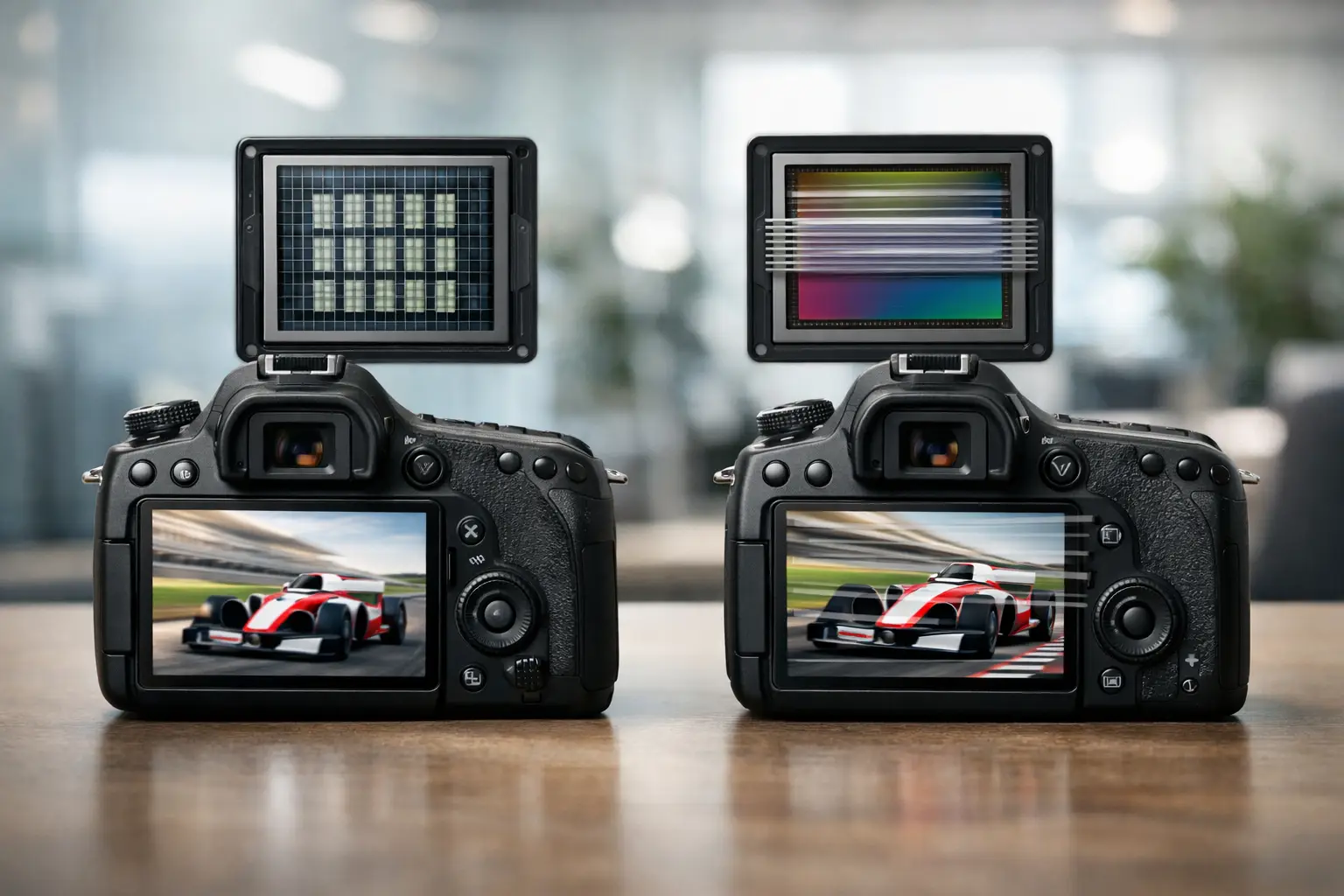
A rolling-shutter sensor exposes and reads image data line by line, usually from top to bottom. The time separating the first row from the last is called the readout time. If the subject or camera moves during that interval, each row records a slightly different moment. The resulting image can show geometric distortion even when the optics and focus are correct.
A global-shutter sensor exposes every pixel at the same instant. The entire frame represents one common point in time, so fast movement does not bend or shear object geometry. After exposure, the image may still be read out in sequence, but the scene information was captured simultaneously. This distinction is what makes global shutter valuable for synchronized machine vision.
Neither architecture is automatically better. Rolling shutter remains widely used because it can provide high resolution, strong low-light performance, lower power consumption, and a favorable cost structure. Global shutter earns its premium when temporal accuracy matters more than maximizing pixels per dollar.
What Rolling Shutter Does Well
Rolling-shutter CMOS sensors are the practical choice for many compact camera modules. They are mature, broadly available, and offered across a wide range of resolutions, optical formats, and interface options, including MIPI CSI-2, USB, and DVP designs. For fixed-scene imaging, a good rolling-shutter module can produce excellent images at an efficient system cost.
This architecture is well suited to applications such as access-control terminals, document scanners with controlled motion, smart displays, remote monitoring cameras, consumer devices, and many IoT products. If the camera is stationary, the field of view is stable, and subjects move slowly, rolling-shutter artifacts may be negligible.
Modern rolling-shutter sensors can also offer high frame rates. That specification should not be confused with distortion resistance. A camera running at 60 frames per second can still distort motion if its row readout time is long relative to scene movement. Frame rate determines how often complete frames are produced. Readout behavior determines whether moving content is geometrically faithful within each frame.
Rolling shutter also requires careful consideration around pulsed LEDs, displays, and industrial lighting. Because rows are exposed at different moments, fluctuating light can create horizontal bands or uneven brightness. Appropriate exposure control, constant-current illumination, and lighting-frequency matching can reduce the effect, but the camera and light must be evaluated as one imaging system.
Where Global Shutter Delivers Clear Value
Global shutter is designed for scenes where movement cannot be paused and measurements cannot be guessed. A fast conveyor, a flying drone, a robotic wrist camera, or a vehicle-mounted inspection system benefits because edges and reference features retain their true shape throughout the frame.
In industrial automation, that capability supports more reliable dimension measurement, object localization, code reading, and defect detection. A global-shutter camera can also synchronize effectively with short strobe pulses. The system can freeze motion with precisely timed illumination, capture a consistent image, and reduce ambient-light influence. This is especially valuable when cycle time is tight or parts have reflective surfaces.
Global shutter is also a strong fit for stereo vision and multi-camera systems. When two cameras capture a moving subject at slightly different times, correspondence calculations can become less accurate. Common exposure timing improves depth estimation and motion analysis, particularly in robotics, automated guided vehicles, and intelligent traffic applications.
For medical and endoscopic imaging, sensor selection requires added nuance. A global shutter can reduce distortion caused by instrument or patient movement, while rolling shutter may offer advantages in pixel count, package availability, sensitivity, or thermal design. The correct architecture depends on the clinical use case, image-processing pipeline, illumination method, and required module diameter.
The Trade-Offs Behind the Sensor Choice
Global shutter traditionally requires additional pixel-level circuitry to store charge or image data during simultaneous exposure. That can reduce the photosensitive area available in each pixel. Depending on the sensor generation and pixel size, the results may include lower sensitivity, reduced full-well capacity, higher noise, or a higher sensor price compared with a similar rolling-shutter part.
Sensor technology has narrowed this gap. Backside-illuminated global-shutter sensors and newer stacked designs can deliver impressive sensitivity and dynamic range. Still, buyers should assess actual measured performance rather than treating the word global as a guarantee of superior image quality.
Rolling shutter can create skew, wobble, partial exposure of fast-moving objects, and banding under certain light sources. Global shutter avoids those temporal artifacts, but it does not eliminate motion blur. Motion blur is primarily determined by exposure duration. If a global-shutter camera uses a long exposure while an object moves quickly, the object will be blurred, although it will not be geometrically tilted by row timing.
A useful distinction is simple: global shutter preserves a single moment; short exposure freezes movement. High-speed applications often require both. That usually means sufficient illumination, an appropriate lens aperture, sensor sensitivity, and tightly controlled trigger timing.
How to Specify the Right Camera Module
The fastest way to avoid an expensive redesign is to define the imaging task before selecting the sensor. Procurement teams should not evaluate shutter type in isolation. Engineering should establish the motion, lighting, optical, mechanical, and data-interface requirements that determine whether a module will work in the finished device.
Key evaluation inputs include:
- Object speed, camera movement, working distance, and acceptable measurement error.
- Required exposure time and whether available lighting can support it.
- Resolution, pixel size, dynamic range, and low-light performance at the required frame rate.
- Trigger, strobe, and multi-camera synchronization requirements.
- Module dimensions, lens constraints, interface, processing bandwidth, production volume, and target cost.
For example, an inspection system imaging a part moving at 2 meters per second may need an exposure of only a few hundred microseconds to limit blur. If the camera uses rolling shutter, engineers must also calculate the total row readout time and determine whether the resulting displacement across the frame is acceptable. If the part must be located to a fraction of a millimeter, a global-shutter sensor and external strobe may be the lower-risk design, even if the initial module cost is higher.
Conversely, a battery-powered smart device that records mostly static scenes may gain more from the lower power and higher resolution available in a rolling-shutter module. Paying for global shutter in that design may not improve the user experience or product performance.
Validate the Complete Imaging Chain
A sensor data sheet is only the starting point. Lens distortion, focus tolerance, image signal processor tuning, cable integrity, electromagnetic conditions, thermal behavior, and host bandwidth can all affect the final image. A global-shutter sensor paired with inadequate lighting or a poorly matched lens will not deliver reliable machine vision results.
Prototype evaluation should reproduce the real operating environment: actual object speed, representative surfaces, production lighting, vibration, temperature range, and trigger sequence. Test for the failures that matter to the application, such as missed codes, false defect calls, inaccurate coordinates, or saturated highlights. This is where custom module development creates value, because sensor selection, optics, PCB layout, mechanical packaging, and firmware settings can be optimized together rather than treated as separate purchases.
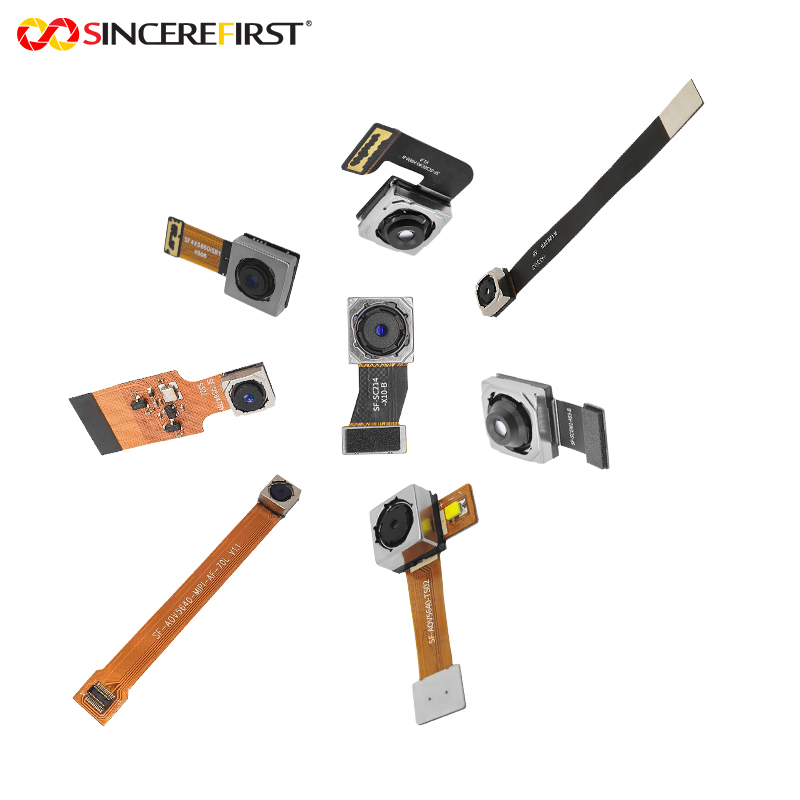
SincereFirst supports this approach with standard and customized camera modules for embedded and industrial imaging programs, helping teams align sensor architecture with interface, optics, packaging, and volume-manufacturing requirements.
Choose for the Failure You Cannot Accept
The best global shutter versus rolling shutter choice begins with a direct engineering question: what image failure would stop this product from doing its job? If bent geometry, timing mismatch, or strobe synchronization would compromise the result, global shutter is usually the disciplined choice. If the scene is stable and cost, sensitivity, resolution, or power efficiency lead the specification, rolling shutter may be the more capable commercial solution.
Start with a representative motion test, not a preference for a sensor label. A camera module that performs predictably on the production line, in the field, and at manufacturing scale is the one worth designing into the product.