
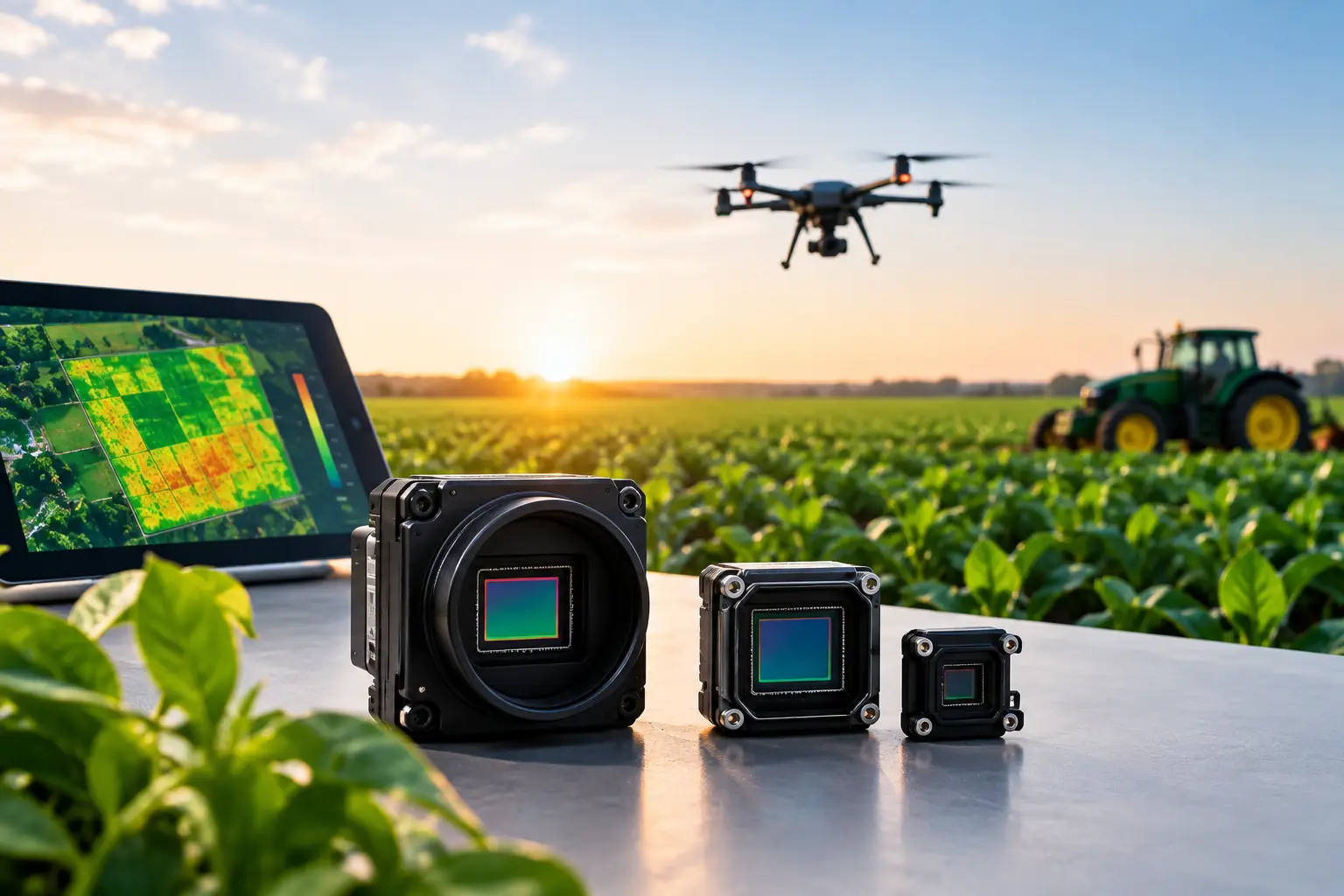
A crop-scanning camera that performs well in a controlled lab can fail quickly when mounted on a tractor, drone, or autonomous rover. Direct sun, dust, vibration, leaf movement, and long working days expose weaknesses in sensor selection. The top image sensors for agriculture are not simply the devices with the highest pixel count. They are sensors whose shutter, sensitivity, spectral response, interface, and supply status fit the machine being built.
For OEMs and system integrators, the decision starts with the imaging task. Detecting weeds at 20 mph, estimating plant vigor from a drone, reading fruit position in a greenhouse, and inspecting seed placement each require different sensor behavior. A practical selection process prevents costly redesigns after optics, illumination, and embedded processing have already been defined.
What makes an image sensor suitable for agriculture?
Agricultural vision systems operate in an unusually wide range of lighting conditions. A camera may move from shadow to full sunlight within seconds, image reflective leaves at noon, and then operate under narrow-band LEDs after dark. Dynamic range, pixel full-well capacity, low-noise performance, and controllable exposure are therefore more useful selection criteria than resolution alone.
Motion is equally important. On a moving implement, leaf edges, row markers, and fruit may shift substantially during an exposure. A global-shutter sensor captures the entire frame at once and preserves geometry. This makes it the preferred architecture for weed recognition, guidance, yield mapping, and fast machine vision. Rolling shutter can reduce cost and increase available resolution, but it is best reserved for stabilized drone imaging, slower inspection, or applications where motion distortion can be calibrated and tolerated.
Spectral requirements define the next branch of the decision. Standard RGB cameras support color grading, fruit sorting, canopy monitoring, and operator-facing imaging. Near-infrared capability is valuable for vegetation analysis because healthy foliage reflects strongly beyond visible red wavelengths. Multispectral systems use carefully selected bands, often including red, red-edge, and NIR, to estimate crop condition. They require more than a suitable sensor: filters, lens transmission, illumination, calibration targets, and processing methods must all support the intended bands.
Top image sensors for agriculture by application
There is no universal winner. The sensor families below are widely used starting points for commercial agricultural cameras, with final suitability depending on optics, frame rate, enclosure design, and software pipeline.
Sony STARVIS and Pregius sensors for low light and motion
Sony STARVIS rolling-shutter sensors, including devices in the IMX335, IMX415, and IMX678 class, are strong candidates for high-resolution RGB monitoring where low-light performance matters. Their back-illuminated pixel designs can support greenhouse observation, fixed field cameras, livestock monitoring, and drone payloads with adequate stabilization. The trade-off is rolling-shutter behavior. They are not the first choice for fast ground vehicles unless exposure time and mechanical movement are tightly managed.
For motion-critical equipment, Sony Pregius global-shutter sensors are often a better fit. Sensors such as the IMX296, IMX304, IMX530, and IMX541 families are used across industrial machine vision because they combine global shutter operation with reliable image quality and established ecosystem support. Resolution and optical format vary significantly across the family. Smaller formats can help reduce camera and lens size, while larger sensors enable wider coverage or higher detail at a given working distance.
Pregius devices are particularly relevant for precision spraying, autonomous navigation, and high-speed fruit or vegetable inspection. Their main trade-offs are module cost, power consumption at high frame rates, and the need for lenses that resolve the selected pixel pitch across the entire field of view.
onsemi AR sensors for embedded machine vision
onsemi AR-series CMOS sensors are a practical option for agricultural equipment that needs industrial shutter control, high frame rates, and embedded-friendly integration. Models in the AR0234, AR0521, AR0821, and AR1335 range are common reference points because they address different balances of resolution, sensor size, and performance.
The AR0234 is well suited to compact stereo vision, row following, and obstacle detection where fast capture and global shutter matter more than megapixel count. A higher-resolution device such as the AR0821 can support wider-area capture or crop-detail analysis while maintaining a manageable embedded processing load. Selection should be confirmed at the module level, not just from a sensor data sheet. MIPI CSI-2 lane count, serializer support, image signal processor compatibility, and thermal conditions can determine whether the camera performs as designed.
OmniVision sensors for compact and cost-sensitive cameras
OmniVision offers broad options for compact camera modules, particularly where board area, power, and bill of materials need close control. Sensor families such as OV9281 have become familiar in machine vision and stereo applications because of their global shutter design and compact format. They can be effective for low-latency navigation cameras, depth systems, and close-range crop or equipment monitoring.
For RGB cameras that require more resolution in a small module, other OmniVision devices may be appropriate, especially in fixed or low-speed installations. The engineering question is not whether a sensor is compact, but whether its pixel size, sensitivity, output format, and shutter behavior match the operating environment. Small pixels can deliver resolution, but may need more light or more careful noise management in dawn, dusk, and shaded canopy conditions.
Multispectral and NIR-ready sensor approaches
For crop health analytics, a conventional color sensor can be insufficient. The preferred approach may be a monochrome global-shutter sensor combined with external bandpass filters, a filter wheel, or multiple synchronized cameras. Monochrome sensors avoid the color filter array that limits light collection and can offer better sensitivity within a selected spectral band.
This configuration requires disciplined optical engineering. Standard lenses may lose transmission in NIR wavelengths, and infrared focus shift can reduce sharpness if the lens is corrected only for visible light. Narrow-band filters also reduce incoming light, which can force longer exposure times or higher-gain operation. For fast-moving field platforms, multi-camera systems with simultaneous capture are often more reliable than sequential filtering.
Sensor selection must include the complete camera module
A sensor data sheet does not guarantee field performance. Agricultural camera development requires the sensor, lens, printed circuit board, image processing, interface, and mechanical package to be evaluated together. An excellent global-shutter sensor paired with an unsuitable lens can still produce poor edge detail, flare, or unacceptable chromatic aberration in bright conditions.
Interface selection also affects product viability. MIPI CSI-2 is efficient for short internal connections to embedded processors and is common in compact OEM equipment. USB 3.0 is attractive for development systems, PCs, and high-bandwidth industrial devices. GMSL or FPD-Link serialization can be necessary when cameras are distributed across larger tractors, harvesters, or robotic platforms and cable runs exceed practical MIPI distances.
Environmental design deserves equal attention. A field-ready vision system needs thermal analysis, lens sealing, anti-fog measures, vibration-resistant connectors, and exposure settings that account for dust and direct sunlight. High dynamic range may help retain information in shadow and highlight areas, but HDR modes can introduce motion artifacts or reduce usable frame rate. Test the selected mode on the actual machine, during the hours and seasons when the equipment will operate.
A practical qualification path for OEM buyers
Start with representative scenes rather than a generic resolution requirement. Capture green leaves, dry soil, reflective irrigation hardware, shaded crop rows, and the fastest expected machine motion. Define the smallest object or feature that must be detected, then calculate the needed pixels on target and select focal length and sensor format together.
Next, compare candidate sensors under the required shutter mode, frame rate, and illumination. Measure signal-to-noise ratio, motion blur, color consistency, NIR response where applicable, and processing latency. Include worst-case temperature and supply-voltage conditions. A camera that works during a short indoor evaluation may not maintain calibration during a long summer field run.
Finally, qualify the manufacturer for the full product lifecycle. Confirm sensor availability, component-change control, module test procedures, optical alignment capability, firmware support, and sample-to-production lead times. For custom agricultural equipment, a supplier that can modify lens selection, connector orientation, PCB shape, cable length, and image tuning can reduce both engineering risk and time to market. SincereFirst supports this module-level approach with custom embedded camera development and scaled manufacturing for OEM vision systems.
The right agricultural sensor is the one that delivers repeatable data when the field is least cooperative. Build the requirement around the crop decision your machine must make, then validate the complete imaging system under real motion, light, and environmental conditions.