
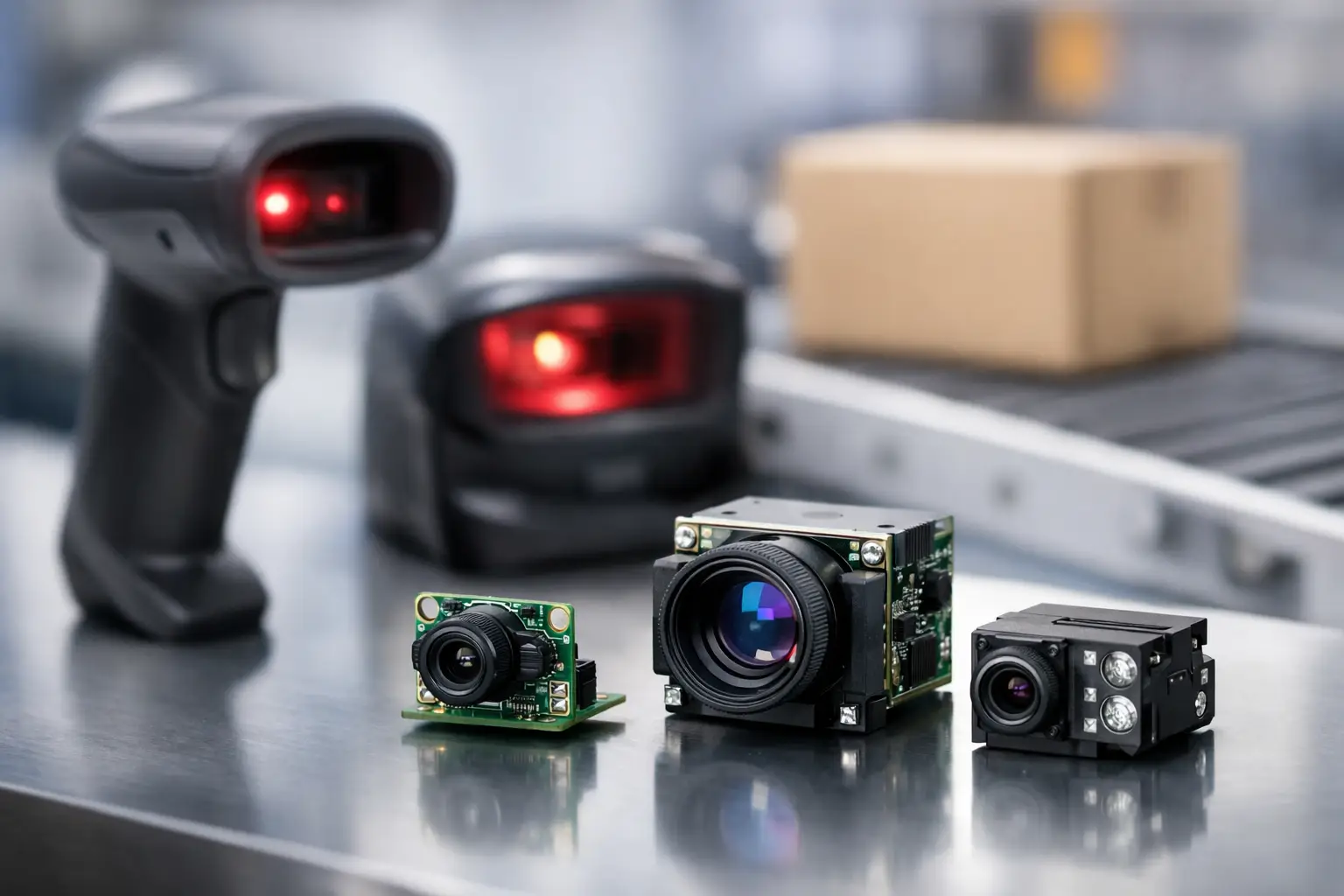
A barcode scanner can fail on a worn warehouse label even when it reads a clean retail code instantly. The difference is rarely resolution alone. When evaluating what camera module suits barcode scanners, product teams must match the image sensor, optics, illumination, interface, and decoding workload to the codes, surfaces, distances, and motion in the actual application.
For OEMs and integrators, the right decision starts by treating the camera module as one part of a complete imaging chain. A module captures usable barcode data. The processor and decoder locate the code, correct distortion, recover contrast, and return a result within the required cycle time. If the captured image lacks detail, has motion blur, or is dominated by glare, even capable decoding software has limited room to compensate.
What Camera Module Suits Barcode Scanners in Practice?
There is no universal barcode camera module. A compact USB module that performs well in a desktop point-of-sale reader may be unsuitable for a forklift terminal, a self-service kiosk, or an industrial direct-part-marking station.
The first decision is the barcode type. One-dimensional codes such as Code 128, EAN, UPC, and Code 39 need sufficient horizontal pixel detail across the narrowest bars. Two-dimensional formats such as QR Code, Data Matrix, and PDF417 require enough pixels across both axes to resolve the smallest cell. Data Matrix codes engraved onto metal, curved parts, or low-contrast plastic create a more demanding imaging task than a printed QR code on a package.
Working distance matters just as much. A scanner designed for 50 to 250 mm may use a compact fixed-focus lens with a moderately wide field of view. A long-range scanner for warehouse shelves needs a narrower field of view, longer focal length, controlled depth of field, and more resolution at the target. Asking for a high-resolution sensor without defining the required field of view often leads to excessive cost, slow processing, or poor close-range performance.
A useful starting point is to define the smallest barcode feature, the largest field of view, the minimum and maximum scan distance, and the required decode time. These inputs allow an engineering team to calculate the pixels available per barcode element rather than selecting a sensor by megapixel count alone.
Select the Sensor for Code Density and Motion
For many close-range 1D and 2D readers, a 1MP to 2MP CMOS sensor provides an effective balance of cost, image rate, module size, and decoding performance. This range is often sufficient for retail terminals, handheld readers, access-control equipment, parcel scanning, and compact smart devices when optics and lighting are correctly matched.
A 3MP, 5MP, or higher-resolution module becomes valuable when the application must read small codes across a wide area, inspect several labels in one image, or maintain performance at longer distances. Higher resolution can also support crop-based decoding, where a processor searches sections of an image rather than requiring the user to position the code precisely. The trade-off is higher bandwidth, greater memory use, increased processing demand, and potentially longer decode latency.
Sensor pixel size deserves attention. Larger pixels can offer improved sensitivity in low light, which helps battery-powered handheld devices or scanners operating in dim stockrooms. However, a larger sensor format may require a larger lens and more mechanical space. The best module is usually the smallest sensor and lens combination that meets the required barcode sampling and lighting conditions.
Global Shutter or Rolling Shutter?
For stationary presentations, kiosk scanning, and user-guided close-range reads, a rolling-shutter sensor can be a practical and economical choice. It is widely available and can deliver strong image quality when the code and camera remain relatively still.
For conveyor systems, vehicle-mounted terminals, high-speed parcel handling, and mobile robots, global shutter is often the safer choice. It captures the entire frame at one instant, reducing skew and blur on moving labels. A rolling shutter can create distorted barcode geometry when the target moves during exposure, making decoding inconsistent even if the image appears generally sharp.
Global shutter is not automatically necessary for every industrial device. It usually carries a cost or sensitivity trade-off. The relevant question is whether the maximum target motion, exposure time, and scan angle can be controlled. If they cannot, global shutter provides more predictable read performance.
Optics Set the Real Scan Range
The lens determines how the sensor’s pixels are used. A camera module with a suitable sensor but the wrong focal length cannot achieve the specified reading distance. Barcode devices should be designed around a defined field of view at the intended working distance, then verified with representative labels.
A wide-angle lens is useful for close-range scanners that must acquire codes quickly without exact alignment. Its limitation is that barcode elements occupy fewer pixels as distance increases, and barrel distortion may become more visible near the frame edges. Lens distortion can be corrected in software, but correction consumes processing resources and may reduce usable edge resolution.
A narrower-angle lens provides higher pixel density on distant codes. It is appropriate for fixed-mount readers on production lines, warehouse scan portals, and long-range equipment. The compromise is a smaller capture zone and greater sensitivity to target position.
Fixed-focus modules are usually preferred for high-volume products because they simplify mechanics and improve consistency in manufacturing. Autofocus can help when the reading range varies widely, but it introduces focus time, power consumption, control complexity, and another possible source of delay. For most dedicated barcode scanners, careful optical design is more reliable than relying on autofocus.
Illumination Often Decides the Decode Rate
Barcode imaging depends on contrast, not just brightness. A printed black-and-white label may decode under broad visible illumination, while a glossy label can produce a bright reflection that erases part of the code. Laser-etched, dot-peened, or chemically marked Data Matrix codes require purpose-designed lighting to reveal the mark against the substrate.
For standard printed labels, integrated LED illumination can provide repeatable exposure independent of ambient light. The LED color should be evaluated with the barcode material, ink, and sensor response. Red illumination is common in barcode devices because it can create useful contrast on many printed labels, while white lighting offers broader application coverage and easier visual alignment.
For difficult direct part marking, a ring light alone may not be enough. Low-angle dark-field lighting can emphasize engraved edges, while diffuse dome lighting can reduce glare on reflective surfaces. Polarizers may help suppress specular reflections from glossy packaging, laminates, and metal. These choices are application-specific, which is why representative sample testing should happen before finalizing the module.
Exposure control also matters. Short exposure freezes motion but requires stronger illumination or a more sensitive sensor. Long exposure improves signal in low light but raises the risk of motion blur. A well-designed scanner balances illumination power, thermal limits, sensor gain, and frame rate rather than forcing one parameter to carry the whole task.
Match the Interface to the Host Platform
Interface selection affects integration time and system architecture. USB 2.0 UVC camera modules are practical for PC-based terminals, development platforms, and products that benefit from standard driver support. USB 3.0 provides more bandwidth for higher-resolution or higher-frame-rate scanner designs and can reduce compression requirements.
MIPI CSI-2 modules are a strong fit for embedded Linux, Android, ARM, and Qualcomm-based hardware where low latency, compact cabling, and direct connection to the application processor are priorities. They require host-side camera driver and image signal processor integration, so they are best suited to teams with embedded software resources or a module partner able to support the platform.
DVP modules remain relevant for certain microcontroller and legacy embedded platforms, particularly where cost and interface simplicity are more important than high data throughput. The correct interface is not the one with the highest specification. It is the one the host can receive, process, and decode within the product’s power, cost, and timing limits.
Build for Manufacturing, Not Just the Lab
A barcode module that works with a hand-selected sample is not yet ready for production. Lens focus tolerance, LED output variation, sensor lot consistency, module alignment, connector reliability, and calibration procedures all affect final read rate. These factors become especially significant when a device will be deployed across thousands of checkout lanes, factory stations, or field-service units.
During supplier qualification, request test data using your actual barcode grades, label materials, code sizes, scan angles, distances, and motion profiles. Confirm the module’s operating temperature range, frame-rate stability, lens mounting method, interface connector, and availability plan. If the camera is installed near machinery, also assess vibration, dust, ambient light changes, and electromagnetic interference.
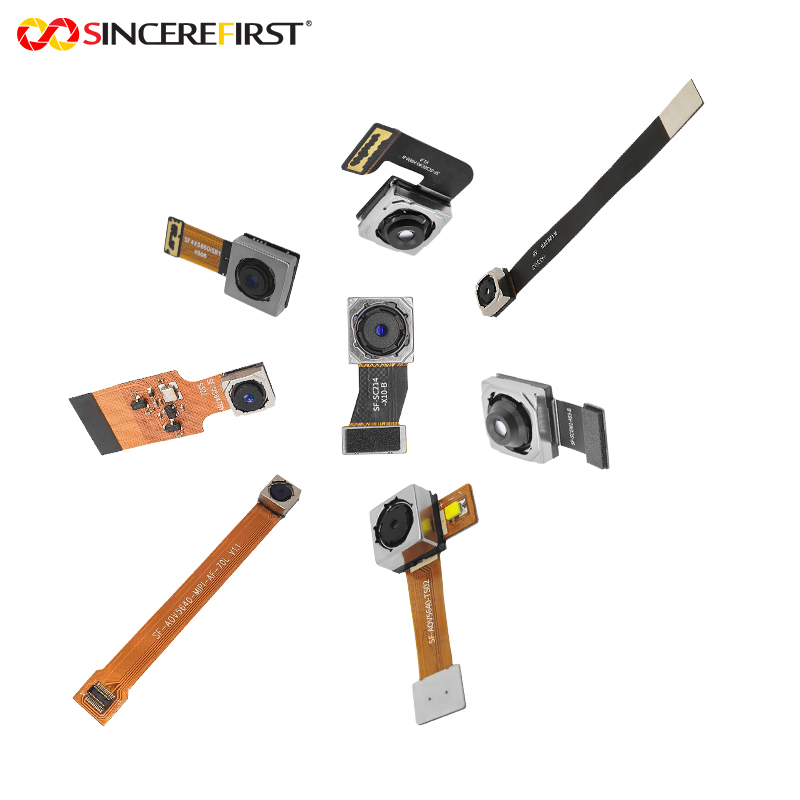
Custom module development can be justified when standard optics do not achieve the required field of view, when the device enclosure imposes strict dimensions, or when illumination must be integrated around a specific mechanical opening. SincereFirst supports this type of work with sensor, lens, interface, FPC layout, and module-form-factor options designed for scalable OEM production.
The most productive next step is to turn the intended scan experience into measurable requirements. Send representative codes, define the acceptable read time and failed-read rate, and specify where the user or moving target will be. Those details make it possible to engineer a barcode camera module that performs consistently after the first prototype leaves the lab.